
What are the Benefits of PoC?

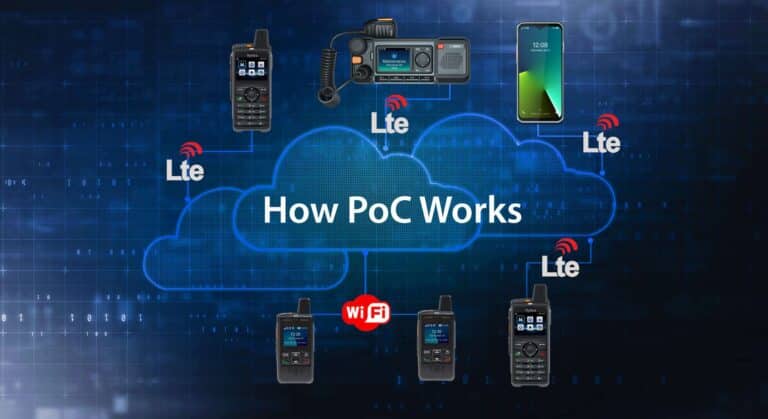
Push-to-Talk over Cellular, or PoC, gives organizations instant group and individual calling over nationwide 4G/LTE and 5G cellular networks and over Wi-Fi networks. The main benefits of PoC include wide-area coverage, flexible cellular and Wi-Fi access, fast deployment without FCC frequency licenses or traditional radio infrastructure, lower up-front deployment costs, unlimited channels and zones, encrypted communications, cross-enterprise calling, large enterprise system management, and improved coverage reliability through multi-carrier SIM support.
For businesses with mobile teams, fleets, multiple locations, temporary worksites, or distributed facilities, PoC delivers the speed of two-way radio communication with the coverage and flexibility of broadband cellular and Wi-Fi networks.
Why Is Nationwide Coverage a Major Benefit of PoC?
Nationwide coverage is one of the most important advantages of Push-to-Talk over Cellular because PoC devices use the existing 4G/LTE and 5G infrastructure of mobile network operators. Traditional two-way radio systems are limited by radio-to-radio range, repeater coverage, antenna placement, building conditions, terrain, and licensed frequency availability. PoC removes many of those limitations by using cellular broadband networks.
This makes PoC especially useful for organizations with users spread across large service areas. A dispatcher can communicate with drivers across a region, a security supervisor can coordinate mobile patrols at multiple properties, and a construction manager can communicate with crews at changing jobsites without installing new radio infrastructure at every location.
PoC is not limited to one facility, one repeater site, or one campus. It can support users across a single building or facility, multiple buildings, many customer sites, vehicle routes, regional operations, and nationwide service areas.
How Does LTE and Wi-Fi Access Improve Communication Flexibility?
PoC devices can communicate over cellular 4G/LTE and 5G networks and Wi-Fi networks. This gives organizations deployment flexibility because users can connect through the best available network for the environment.
Many PoC devices can seamlessly switch between Wi-Fi and LTE when a user moves out of Wi-Fi range. This helps maintain communication continuity without requiring the user to manually change networks. A worker can leave a facility, enter a vehicle, and continue using the same PoC radio as the device transitions to cellular coverage.
Wi-Fi access can also reduce the need for SIM-based cellular service for users who remain inside one facility. Cellular access becomes more important for mobile personnel, outdoor operations, fleets, and users who travel between locations.
Why Are PoC Systems Faster to Deploy Than Traditional Radio Systems?
PoC systems can be deployed quickly because they use existing 4G/LTE and 5G cellular networks and Wi-Fi networks. A traditional radio system may require FCC frequency licensing, repeater installation, antenna system design, site surveys, cabling, combiners, duplexers, power systems, shelter space, and ongoing infrastructure maintenance. PoC avoids much of that complexity.
With PoC, devices can often be preconfigured with:
- User names
- Talk groups
- Zones
- Emergency settings
- Dispatch permissions
- Encryption settings
- SIM cards
- Wi-Fi settings
- Button assignments
This makes PoC a strong option for organizations that need communications fast. Temporary events, new facilities, emergency deployments, construction projects, seasonal operations, expanding fleets, and growing security teams can benefit from a system that can be activated without waiting for radio infrastructure to be installed.
Does PoC Require FCC Frequency Licenses?
No. Push-to-Talk over Cellular does not require customers to obtain FCC frequency licenses for UHF or VHF radio channels because PoC runs over cellular broadband and Wi-Fi networks. This is a major advantage in urban and high-density areas where available radio spectrum can be limited, difficult to acquire, or expensive to coordinate.
For many commercial organizations, eliminating FCC licensing removes a major planning barrier. It also helps avoid the delays associated with spectrum coordination and system engineering for traditional LMR systems.
How Does PoC Lower Up-Front Deployment Costs?
PoC can reduce up-front deployment costs because organizations do not need to purchase and install traditional radio network infrastructure. There is typically no need for repeaters, towers, antennas, leased tower space, duplexers, combiners, RF cabling, base station equipment, or FCC frequency coordination.
The cost model is usually based on PoC devices and service subscriptions. This shifts the system from a large capital infrastructure project to a more predictable operating expense. For many organizations, this makes it easier to add users, expand locations, and scale service as operational needs change.
A subscription model also helps businesses avoid investing in depreciating infrastructure that must be housed, powered, protected, updated, and maintained.
Why Are Unlimited Channels and Zones Useful?
Unlimited channels and zones enable flexible group and individual calls and make PoC systems easier to organize for large and complex operations.
In traditional radio systems, channel capacity is tied to available frequencies, time slots, repeaters, and system design. Channels are typically used for group calls (or talk groups), so the more channels, the more group calling capacity.
With PoC, group calls are software-defined and can be organized around departments, facilities, job functions, emergency procedures, service regions, or customer accounts.
Group calls can separate communication by team or purpose
Examples include:
- Security
- Maintenance
- Housekeeping
- Transportation
- Facilities
- Emergency all-call
- Management
- Safety
- Quality Control
- Regional operations
- Location-specific teams
- Contractor coordination
- Event operations
- Mobile patrols
Zones can organize multiple channels into logical groups so users can move between related talk groups more easily. Think of zones as folders that organize call groups.
This structure helps reduce radio traffic clutter. Users only monitor the groups relevant to their role while supervisors and dispatchers can access broader communication groups when needed.
How Does PoC Encryption Improve Communication Privacy?
PoC systems can support encrypted voice and data communications to help protect business communication from unauthorized listeners. Encryption is especially important for organizations that discuss security incidents, patient logistics, building access, transportation issues, operational problems, or private business information.
Encryption can be enabled through system management tools, and access can be controlled so only authorized devices and users participate in encrypted communications. This gives organizations more control over who can hear specific groups and helps reduce the risk of sensitive communications being exposed.
What Is Cross-Enterprise Calling and Why Does It Matter?
Cross-enterprise calling allows authorized users from different organizations to communicate in shared PoC call groups when they are on the same compatible PoC platform. This is valuable because many operations involve more than one company.
For example, a security contractor may need to communicate with a property manager. A school district may need to communicate with a transportation provider. A venue may need to connect event staff, security, parking, and maintenance contractors. A logistics company may need to coordinate with warehouse teams or third-party carriers.
Cross-enterprise calling helps solve a common interoperability problem. Instead of forcing every organization to use the same private radio system or carry multiple radios, approved users can join shared talk groups while still keeping their internal communications separate.
This makes PoC useful for:
- Contract security for multiple venues and locations
- Event operations and security
- School transportation with private companies
- Hospitality and resort services
- Construction contractors and subcontractors
- Property management and maintenance companies
- Healthcare support services and EMT transport
- Logistics partnerships
Cross-enterprise groups should be planned carefully so users only access the talk groups they need.
How Does PoC Help Large Enterprises Manage Communications?
Large companies and organizations often need more than push-to-talk calling. They need centralized control over hundreds or thousands of users, locations, groups, devices, permissions, reports, and privacy settings. Modern PoC platforms can support system operations management tools that allow large organizations to administer their communications system across multiple locations.
Enterprise PoC management can include:
- Creating local, regional, and enterprise-wide groups
- Updating call groups across the system
- Managing users and devices
- Adding and removing users
- Programming radios remotely
- Enabling encryption levels
- Reviewing traffic reports
- Supporting private branding
How Does Multi-Carrier SIM Reliability Improve PoC Coverage?
Multi-carrier SIM support improves practical PoC reliability by allowing devices to access more than one mobile network operator. If one carrier has weak service in a particular area, a multi-carrier SIM can help the device connect through another supported carrier.
This is important because no cellular carrier has perfect coverage everywhere. Buildings, rural areas, terrain, network congestion, and local dead zones can affect performance. Multi-carrier SIM support helps reduce dependence on a single network and can improve coverage continuity for mobile teams.
Multi-carrier SIM cards are pre-programmed with three carriers with a specific access order. The first carrier is the default for all calls, the second and third carriers are sequential backups if coverage is lost.
Conclusion: Why Choose Push-to-Talk over Cellular?
Push-to-Talk over Cellular gives businesses instant wide-area communications without the infrastructure burden of traditional radio systems. The most important PoC benefits are nationwide LTE coverage, Wi-Fi flexibility, seamless network switchover, fast deployments, no FCC frequency licenses, lower up-front costs, unlimited channels and zones, secure encrypted calling, cross-enterprise collaboration, enterprise system management, and multi-carrier SIM reliability.
For organizations with mobile employees, distributed locations, fleet vehicles, or rapidly changing communication needs, PoC provides a practical way to connect teams with one-button group calling and modern broadband capabilities.
Frequently Asked Questions
Yes. PoC is well suited for companies with multiple locations because users can communicate over LTE and Wi-Fi without installing a separate radio system at each site. Enterprise management tools can also organize call groups by location, department, region, or role.
Yes. Because PoC uses existing cellular and Wi-Fi networks, organizations can reduce or avoid the maintenance associated with repeaters, antennas, towers, base stations, and other traditional radio infrastructure.
Yes. PoC is a strong fit for temporary worksites and events because devices can be deployed quickly without FCC licensing or radio infrastructure installation. This is useful for construction sites, festivals, conventions, security deployments, and seasonal operations.
Not exactly. Unlimited channels means the system can support a large number of software-defined channels or talk groups for organizing users. Actual simultaneous call performance depends on the PoC platform, device performance, network quality, server capacity, and system configuration.
PoC can work inside buildings through LTE cellular coverage or Wi-Fi. For large facilities, a strong Wi-Fi network can improve indoor performance, especially in areas where cellular signal penetration is weak.
If the device supports LTE and is configured properly, it can switch from Wi-Fi to cellular service when it leaves Wi-Fi coverage. This allows users to continue communicating as they move from a building to a vehicle or outdoor area.
Multi-carrier SIM support is important for fleets because vehicles may travel through areas where one carrier has better service than another. Access to multiple carrier networks can improve coverage continuity across routes.
Yes. Channels, zones, and talk groups can be organized by role, department, location, or task. This helps users hear only the conversations that matter to their work while still allowing supervisors and dispatchers to reach broader groups when needed.
Not always. PoC is best for wide-area, flexible, and fast-deployment communication. DMR may still be preferred for dedicated local radio coverage, private infrastructure, or mission-critical site communications. Many organizations benefit from using both systems together through a PoC bridge or gateway.