
How to Choose the Best PoC Service

The best Push-to-Talk over Cellular system is more than a PoC radio and a monthly subscription. It should include reliable cloud server infrastructure, nationwide access to 4G/LTE and 5G cellular networks, flexible Wi-Fi connectivity, multi-carrier SIM support, professional dispatch software, GPS tracking, secure encrypted communication, an admin portal for user and talk group management, scalable subscription service, and purpose-built PoC radios for different job roles. A strong PoC system should be easy to deploy, simple for workers to use, and powerful enough for large organizations with multiple users, locations, fleets, departments, and operating environments.
What Is a Push-to-Talk over Cellular System?
A Push-to-Talk over Cellular system, often called a PoC system, is the complete communication ecosystem that delivers instant push-to-talk service over broadband networks. It is not just a radio. It is not just a mobile app. It is not just a SIM card or cloud subscription.
A professional PoC system includes the platform, service, network access, devices, dispatching tools, administrator controls, and support structure that make wide-area push-to-talk communication work reliably.
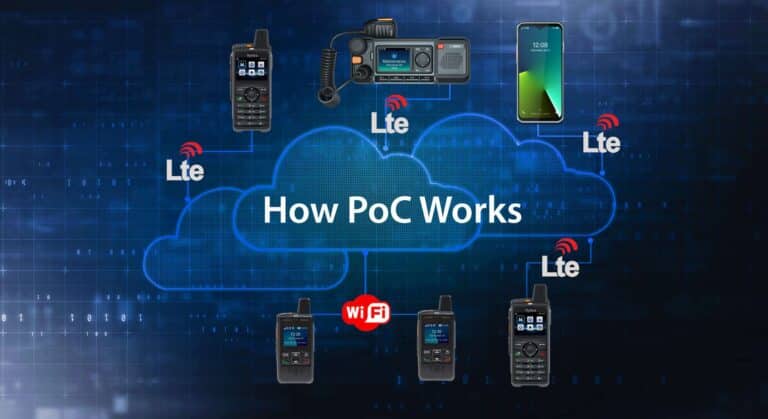
From the user’s perspective, PoC feels like a two-way radio. The user presses a push-to-talk button, speaks to an individual or group, releases the button, and waits for a reply. Behind the scenes, the device connects through 4G/LTE and 5G cellular networks or Wi-Fi to a PoC platform that manages users, talk groups, permissions, dispatch access, location tracking, and call routing.
The system is what makes the service dependable. When evaluating PoC providers, buyers should look beyond the device and ask how the full ecosystem works.
What Components Make Up a Professional PoC Ecosystem?
A complete Push-to-Talk over Cellular ecosystem includes several connected components. Each one affects reliability, usability, scalability, and long-term value.
PoC Radios and Devices
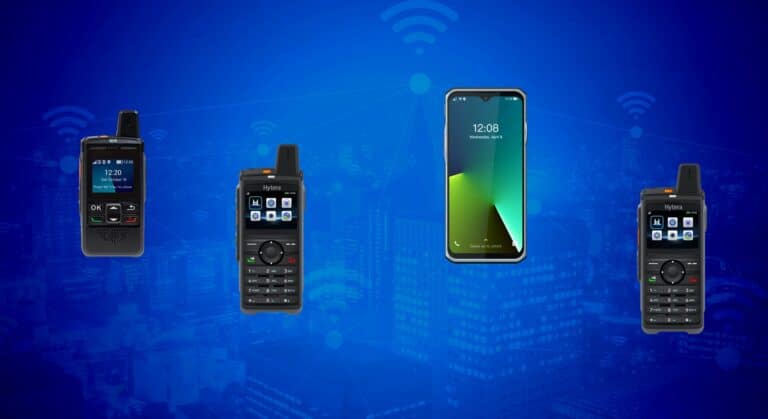
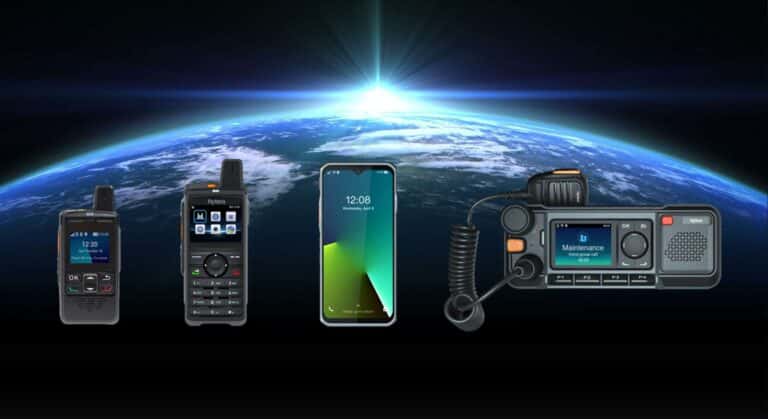
PoC radios and devices are the hardware employees use every day. These may include compact handheld PoC radios, full-featured handheld radios, vehicle-mounted mobile radios, and smart devices with Android business applications. The right system should support different device types for different roles.
Frontline users may need rugged radios with physical PTT buttons, loud audio, emergency buttons, long battery life, and accessory support. Drivers may need mobile radios with vehicle installation, clear audio, GPS, and safe push-to-talk operation. Supervisors or workflow users may need smart devices with cameras, barcode scanning, business apps, and messaging.
PoC Subscription Service
The subscription service provides access to the PoC platform, cellular data service, SIM connectivity, call routing, user accounts, talk groups, and other managed features. This is what shifts PoC from an infrastructure-heavy radio system to a service-based communication model.
A strong subscription service should be transparent, scalable, and aligned with how the organization uses the system. Buyers should understand what is included, what is optional, and which features may require additional licensing.
Cloud Platform
The cloud platform is the core infrastructure that manages the PoC service. It connects users, routes calls, controls groups, manages permissions, and supports dispatching and system administration.
Server reliability matters. A professional PoC platform should use redundant, monitored, and scalable cloud infrastructure. Geo-diverse redundancy is especially valuable because it helps reduce the risk of service interruption if one server location or data center has a problem.
Dispatch Software
Dispatch software gives supervisors, dispatchers, and operations managers a centralized interface for managing communication and fleet operations. It can support group calling, individual calling, map-based user selection, GPS tracking, geofencing, emergency alerts, route history, messaging, image sharing, video, and reporting.
Dispatching is especially important for fleets, security operations, transportation teams, hospitality properties, healthcare campuses, logistics companies, and large facilities where supervisors need visibility into where people and vehicles are located.
Cellular SIM and Carrier Access
PoC devices use SIM cards to access 4G/LTE and 5G cellular networks. This carrier access is one of the main reasons PoC can provide wide-area communication without customer-owned repeaters or FCC frequency licenses.
Not all carrier access is equal. Some systems rely on a single carrier. Stronger systems may offer multi-carrier SIM support, allowing devices to access more than one carrier network when service conditions change.
Admin Portal
The admin portal is the management interface used to configure users, devices, talk groups, permissions, dispatch access, encryption settings, reporting, and other system functions. For small teams, basic administration from the initial systems configuration may be enough. For large enterprises, the admin portal becomes one of the most important parts of the system.
A good admin portal should make it easy to add users, remove users, organize groups, assign radios, update settings, segment teams by location, and manage the system as the organization grows.
Full System Ecosystem
The full ecosystem is how all these parts work together: radios, subscription service, cloud platform, dispatch software, carrier access, admin portal, support, and integration options. The best PoC system is not the one with only the best device or the lowest monthly fee. It is the system that delivers reliable communication across the complete user experience.
Why Choosing the Right PoC System Matters
PoC systems can look similar on the surface. Many providers advertise nationwide coverage, group calling, GPS tracking, and fast setup. The real differences show up in server reliability, carrier access, device quality, dispatch features, admin control, encryption, scalability, and support.
A basic PoC service may work for a small team with simple communication needs. But larger organizations need more than basic push-to-talk. They need a system that can support departments, locations, mobile workers, vehicles, contractors, dispatchers, emergency alerts, and long-term growth.
The wrong system can create operational problems:
- Missed calls
- Poor audio quality
- Weak coverage in key areas
- Limited talk group control
- Complicated user administration
- Weak dispatch tools
- Device failures
- Limited reporting
- Lack of integration with existing radio systems
- Unexpected add-on costs
The right system should make communication faster, clearer, and easier to manage.
How Reliable Is the Cloud Platform?
Cloud platform reliability is one of the most important factors in choosing a PoC system. Because PoC calls are routed through the platform, the server infrastructure must be dependable.
A professional PoC platform should offer:
- Redundant server infrastructure
- Geo-diverse cloud architecture
- High-capacity call handling
- System monitoring
- Scalable user support
- Reliable dispatch connectivity
- Fast recovery if a service issue occurs
Ask the provider how the platform is hosted, how redundancy works, whether the service has experienced outages, and how the system is monitored. For business-critical communication, cloud reliability is not a minor technical detail. It is central to the value of the system.
Does the System Support Nationwide 4G/LTE and 5G Cellular Networks?
One of the biggest advantages of PoC is wide-area coverage using 4G/LTE and 5G cellular networks. This allows users to communicate across facilities, cities, regions, job sites, routes, and mobile service areas without building traditional radio infrastructure.
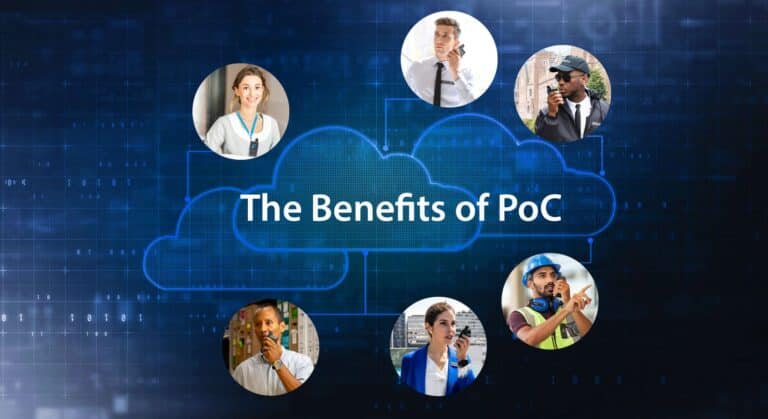
Nationwide cellular access is especially valuable for:
- Mobile security patrols
- School transportation
- Delivery fleets
- Shuttle operations
- Field service teams
- Construction companies
- Regional supervisors
- Logistics teams
- Maintenance vehicles
- Multi-site organizations
Coverage should still be evaluated realistically. No carrier network covers every building, basement, rural area, warehouse, parking garage, or remote worksite perfectly. The best providers help customers evaluate real-world coverage where their teams actually operate.
Does the System Support Multi-Carrier SIM Reliability?
Multi-carrier SIM support can improve PoC reliability by allowing devices to access more than one mobile carrier network. If one carrier has weak coverage in a specific area, a multi-carrier SIM may help the device connect through another supported network.
This is especially important for mobile teams because cellular coverage changes by location. A fleet vehicle, mobile patrol, or field technician may travel through areas where one carrier performs well and another does not.
When evaluating multi-carrier SIM support, ask:
- Does the system support multiple carrier networks?
- Is multi-carrier SIM included or optional?
- How does the device move between networks?
- Are all PoC devices compatible with multi-carrier SIMs?
- Can the provider help test coverage on real routes and work areas?
For fleets and mobile teams, multi-carrier reliability can be a major differentiator.
Can the System Use Both Cellular and Wi-Fi?
A strong PoC system should support both cellular and Wi-Fi connectivity. This gives organizations more deployment flexibility.
Wi-Fi may be useful inside facilities with strong wireless networks. Cellular coverage is more useful for vehicles, outdoor spaces, remote sites, and users who move between locations. Many organizations benefit from using both.
Examples include:
- A hotel using Wi-Fi inside the property and cellular service for shuttles and parking teams.
- A school using Wi-Fi on campus and cellular service for buses.
- A warehouse using Wi-Fi indoors and cellular service in yards and loading areas.
- A construction company using cellular service at changing job sites and Wi-Fi in temporary offices.
The best PoC devices and systems should make the network experience simple for users. The user should focus on communication, not on managing network settings.
How Easy Is the PoC System to Deploy?
Fast deployment is one of the biggest advantages of PoC. Because PoC uses existing cellular and Wi-Fi networks, organizations can often deploy communication faster than they could with a traditional radio infrastructure project.
A professional PoC system should allow devices to be configured before they reach the customer. Radios can be prepared with user names, talk groups, zones, emergency settings, dispatch permissions, SIM cards, and Wi-Fi settings.
Fast deployment is valuable for:
- New facilities
- Temporary events
- Construction projects
- Security contracts
- Seasonal operations
- Expanding fleets
- Emergency replacement systems
- Multi-site rollouts
Speed matters, but planning still matters. A PoC deployment should include a clear talk group plan, naming convention, user list, device assignment process, dispatch configuration, and training.
Does the System Provide Flexible Talk Groups, Channels, and Zones?
A professional PoC system should make it easy to organize users into the right communication groups. Talk groups, channels, and zones allow the system to match how the organization actually works.
A business may need groups for:
- All users
- Emergency calls
- Security
- Maintenance
- Transportation
- Operations
- Supervisors
- Front desk
- Housekeeping
- Warehouse
- Dispatch
- Mobile patrols
- Regional teams
- Customer sites
Unlike traditional radio systems, PoC groups are software-defined. That means the system can usually support a large number of virtual channels, talk groups, or zones. Buyers should confirm whether these are included or whether the provider charges extra for normal system organization.
Does the PoC subscription provide all the virtual channels and talk groups for free, or is there a monthly up-charge?
Does the System Include Professional Dispatch Software?
Dispatch software is one of the most important parts of a complete PoC ecosystem. It gives authorized users a central interface to communicate with people in the field, track location, respond to incidents, and coordinate activity.
A strong PoC dispatch application may include:
- Group calling
- Individual calling
- Dynamic call groups
- Map-based user selection
- GPS tracking
- Route history
- Breadcrumb trails
- Geofencing
- Emergency alerts
- Text messaging
- Image sharing
- Video support
- Call logs
- Message logs
- Alarm logs
- Reporting
Dispatching is valuable because it turns PoC from a basic push-to-talk service into an operational communication platform.
Why Is Web-Based Dispatch Important?
Web-based dispatch software can be easier to deploy and manage than traditional client/server dispatch software. Authorized users can access the dispatch interface through a web browser rather than relying on installed software on a specific workstation.
This can provide several advantages:
- Faster deployment
- Easier updates
- Less IT burden
- Flexible access from approved locations
- Easier support for multiple dispatchers
- Better scalability for growing organizations
For many businesses, web-based dispatch is the practical choice because it reduces complexity while keeping dispatch tools accessible to the people who need them.
Does the System Include GPS Tracking and Geofencing?
GPS tracking is a major benefit of PoC for organizations with mobile workers, vehicles, or distributed teams. Many PoC devices include GPS, and the dispatch software can show user locations on a map.
GPS tracking can help organizations:
- Find the closest worker or vehicle.
- Confirm arrival at a location.
- Review routes and travel history.
- Monitor patrol coverage.
- Support emergency response.
- Improve dispatch decisions.
- Document field activity.
Geofencing adds another layer of operational control by creating virtual boundaries on a map. The system can generate alerts when a device enters or leaves a defined area. This can be useful for routes, job sites, campuses, restricted areas, service territories, and patrol zones.
Does the PoC subscription provide GPS for free, or is there a monthly up-charge?
Does the System Support Cross-Enterprise Calling?
Cross-enterprise calling allows approved users from different organizations to communicate through shared PoC talk groups. This is useful when multiple companies need to coordinate work without merging their entire communication systems.
Examples include:
- A security contractor communicating with a property manager.
- A school district communicating with a transportation provider.
- A venue connecting security, parking, maintenance, and event staff.
- A logistics company communicating with a warehouse team.
- A construction general contractor coordinating with subcontractor supervisors.
Cross-enterprise calling should be permission-based. Each organization should keep its internal communication separate while sharing only the groups needed for joint operations.
Does the System Include Enterprise Administration?
Enterprise administration is the ability to centrally manage the PoC system across users, devices, groups, locations, permissions, and reporting. This is especially important for larger organizations.
Enterprise administration may include:
- User creation and removal
- Device assignment
- Talk group management
- Zone management
- Location-based segmentation
- Department-based segmentation
- Over-the-air updates
- Encryption settings
- Traffic reporting
- Custom branding
- Role-based permissions
- Multi-site administration
A system that works for 20 users may not be enough for 500 or 2,000 users unless the admin portal is built for enterprise control. Large organizations should evaluate management features as carefully as they evaluate radio features.
Does the System Support Secure and Encrypted Communication?
A professional PoC system should include security controls that help protect voice and data communication. Encryption is important when teams discuss security activity, transportation, facility access, operational issues, customer service, or internal business activity.
Buyers should ask:
- Does the system support end-to-end encryption?
- Can encryption settings be managed centrally?
- Are users controlled by role or permission?
- Can lost or unauthorized devices be disabled?
- Are dispatch users protected by login credentials?
- Can users be removed quickly when they leave the organization?
Security should include both communication protection and administrative control.
Does the System Support Multimedia Communication?
Modern PoC systems can support more than voice. Depending on the device and platform, users may be able to send texts, images, video clips, or live video.
Multimedia communication can be useful when voice alone is not enough:
- A security officer can send a photo of a vehicle or incident.
- A maintenance worker can share an image of damaged equipment.
- A dispatcher can send written instructions.
- A supervisor can review video from a field user.
- A logistics team can document a delivery issue.
Not every user needs multimedia features. Some employees only need simple voice communication. The best system gives organizations the flexibility to match device capabilities to job roles.
Does the System Support Purpose-Built PoC Radios?
The device experience matters. Smartphone apps may be useful for some managers or occasional users, but frontline employees often need purpose-built PoC radios.
Purpose-built PoC radios can offer:
- Physical PTT buttons
- Loud audio
- Rugged housings
- Emergency buttons
- Long battery life
- GPS support
- Accessory compatibility
- Glove-friendly operation
- Vehicle installation options
- Simplified controls
A complete PoC system should support a range of devices, including compact handheld radios, full-featured handheld radios, mobile radios for vehicles, and smart devices for users who need Android business apps, cameras, barcode scanning, or data features.
Can the PoC System Connect to Existing DMR or Analog Radio Systems?
Many organizations already have existing DMR or analog radio systems. A strong PoC strategy should allow those organizations to preserve useful infrastructure while adding wide-area broadband communication.
PoC can connect to existing radio systems through a compatible Radio over IP gateway or bridge. This allows PoC users to communicate with DMR or analog radio users.
This is useful when:
- A campus uses DMR radios but needs PoC for buses or mobile teams.
- A security company uses DMR at a site and PoC for mobile patrols.
- A facility wants to add remote users without replacing its local radio system.
- A business wants to migrate gradually from analog or DMR to PoC.
- A dispatcher needs to coordinate local radio users and wide-area PoC users.
Hytera BRIDGE provides a practical way to connect PoC users with existing third-party, DMR, or analog radio systems.
What Reporting and Logs Should the System Provide?
Reporting helps organizations understand how the communication system is being used. A professional PoC system should provide visibility into calls, messages, users, alarms, geofences, GPS history, and system activity.
Useful reporting features may include:
- Call logs
- Message logs
- Emergency alarm logs
- GPS history
- Geofence alerts
- User activity
- Device status
- System traffic reports
- Exportable records
Reports can support training, incident review, route verification, staffing decisions, and system optimization. For large organizations, reporting can also help identify overloaded talk groups, inactive users, or system changes that need to be made.
What Questions Should You Ask Before Choosing a PoC System?
Before choosing a Push-to-Talk over Cellular system, ask:
- How reliable is the cloud platform?
- Does the platform use geo-diverse server redundancy?
- Does it support 4G/LTE and 5G cellular networks?
- Does it support Wi-Fi?
- Does it support multi-carrier SIM access?
- Are talk groups, channels, and zones included?
- Does the system include professional dispatch software?
- Is GPS tracking included?
- Does it support geofencing?
- Does it support cross-enterprise calling?
- Does it support encryption?
- Can administrators manage users and groups centrally?
- Can the system scale to hundreds or thousands of users?
- Does it support purpose-built PoC radios?
- Does it include mobile radios for vehicles?
- Can it connect to DMR or analog radio systems?
- What support is available from the provider or dealer?
The best PoC system is the one that matches the organization’s real communication workflow, not just the one with the longest feature list.
What Should You Look for in a PoC Subscription Contract?
A PoC subscription contract should be clear, straightforward, and easy to compare. It should explain which devices, service plans, SIM or carrier access, talk groups, dispatch features, GPS tracking, video, encryption, warranty coverage, support terms, and management tools are included.
Buyers should look closely at what is included in the base subscription and what costs extra. Some PoC providers charge separately for features that many organizations consider core system functions, such as GPS tracking, and additional talk groups. These add-ons can change the real cost of the system.
Also review whether pricing is transparent or difficult to compare. Custom quotes are common for larger systems, but the proposal should still make the pricing structure clear. Ask whether costs change after a promotional period, whether SIM or carrier access is included, whether dispatch seats are included, and whether additional users, devices, or features require a higher service tier.
A professional PoC provider should make it easy to understand the full subscription package before you buy. Clear pricing, defined feature sets, and simple renewal terms help organizations compare providers more accurately and avoid unexpected costs later.
How Should You Evaluate Overall Value and Total Cost of Ownership?
A Push-to-Talk over Cellular system is a long-term investment in professional communication for your company. The best value is not always the lowest up-front price or the most complex enterprise package. The best value comes from the complete system: durable radios, reliable PoC service, cellular access, dispatch software, GPS tracking, security features, admin tools, warranty coverage, support, and room to grow.
Total cost of ownership includes the initial device cost, subscription fees, SIM or carrier access, dispatch licenses, accessories, replacement batteries, warranty coverage, support, software features, and future expansion. A system that looks inexpensive at first may cost more over time if key features are optional, devices need to be replaced frequently, or the platform cannot scale with the organization.
Organizations should compare providers based on both price and operational value. A professional-grade PoC system should deliver reliable service, clear audio, strong device durability, simple administration, dispatch visibility, transparent subscription terms, and scalable system management. The goal is to choose a system that supports daily operations for years, not just one that meets the lowest initial budget.
Conclusion: What Is the Best PoC System for Business Communication?
The best Push-to-Talk over Cellular system combines the right radios, subscription service, cloud platform, dispatch software, cellular SIM access, admin portal, security controls, and support model. Each part of the ecosystem matters.
For small teams, the priority may be fast deployment, simple setup, and low up-front cost. For fleets, the priority may be multi-carrier reliability, mobile radios, GPS tracking, and dispatch visibility. For large organizations, the priority may be enterprise administration, reporting, cross-location talk groups, security controls, and scalability.
A professional PoC system should help teams communicate instantly, coordinate work efficiently, and scale as the organization grows.
Frequently Asked Questions
A PoC system includes the radios or smart devices, subscription service, cloud platform, dispatch software, cellular SIM or carrier access, admin portal, user management, talk groups, security controls, and support services that deliver push-to-talk communication over cellular and Wi-Fi networks.
No. A PoC radio is only the device used by the employee. The PoC system includes the device, cloud platform, subscription service, SIM access, dispatch software, admin portal, and management tools that make the service work.
The most important feature is reliable communication. A PoC system should have dependable servers, strong cellular and Wi-Fi access, clear audio, purpose-built devices, and enough management control to support the organization’s users, locations, and workflows.
Yes. Multi-carrier SIM support can improve practical coverage by allowing devices to access more than one carrier network. This is especially useful for fleets, mobile patrols, field service teams, construction crews, and organizations that operate across multiple service areas.
Not every organization needs dispatch software, but dispatching is highly valuable for fleets, security teams, transportation operations, and multi-site organizations. Dispatch software adds centralized calling, GPS tracking, geofencing, route history, emergency alerts, and reporting.
The best PoC systems can use both. Wi-Fi is useful inside facilities with strong wireless coverage, while cellular service is better for vehicles, outdoor areas, remote sites, and mobile teams. Many organizations use Wi-Fi indoors and 4G/LTE and 5G cellular networks outside the facility.
PoC radios can replace DMR radios in some wide-area business communication use cases, but not all. DMR may still be preferred for dedicated local radio coverage, private infrastructure, or environments requiring direct radio system control. Many organizations use PoC and DMR together through a bridge or gateway.
Enterprise PoC management is the ability to centrally control users, devices, talk groups, zones, locations, permissions, reporting, encryption settings, and system configuration. It is important for organizations with many users, departments, or locations.
Many professional PoC systems can support a large number of virtual channels, zones, or talk groups. Buyers should confirm whether talk groups are included, limited, or charged as an add-on.
Compare PoC providers by evaluating cloud reliability, coverage options, multi-carrier SIM support, dispatch capabilities, device quality, encryption, admin tools, DMR integration, reporting, support, and total cost. The best provider should match both current communication needs and future growth.