
What is Two-Way Radio Encryption?

How Digital Encryption Ensures Private and Secure Radio Communications
Digital Mobile Radio (DMR) and Push-to-Talk over Cellular (PoC) technologies have significantly enhanced two-way communication, offering improved voice quality, greater coverage, and advanced features compared to traditional analog systems. One crucial advancement in both Hytera DMR and PoC radios is the implementation of AES encryption, which ensures secure communication.
Analog Scrambling
Older analog radios use a technique called scrambling to provide a practical way to add a layer of privacy to two-way radio communications. Unlike encryption, which requires complex algorithms, scrambling rearranges the audio signal to make it unintelligible to unintended listeners. Scrambling has several vulnerabilities that can compromise its effectiveness. Unlike digital encryption, scrambling doesn’t use complex algorithms, providing only a basic level of security. Scrambling patterns are relatively simple and can be deciphered with the right equipment and expertise, making it easier to intercept communications. Advances in technology make it easier to break scrambling codes, rendering this method less effective against sophisticated interception methods.
Digital Encryption
Digital encryption provides the maximum level of security and privacy for individual calls (one to one) and group calls (one to many). The two commonly used encryption algorithms used to encrypt digital voice and data transmitted over a radio network are ARC4 (Alleged RC4) and AES (Advanced Encryption Standard). ARC4 is a stream cipher known for its simplicity and speed. It works by generating a pseudo-random keystream using a Boolean logic operation with plaintext (original message) to produce the ciphertext (encrypted message). AES, on the other hand, is a block cipher that provides a higher level of security compared to ARC4. It operates on fixed-size blocks of data (typically 128 bits) to encrypt the transmission of digital voice and data. AES also uses keys of varying lengths (128 bits for 32 characters, or 256 bits for 64 characters) that are used for the radio system to verify that the radio is an approved and secure device that can communicate on the system.
ARC4 and AES are also used to encrypt GPS data transmitted over a network to ensure the location of radios and users is secure and private.
How Encryption Works with Push-to-Talk over Cellular
AES or ARC4 encryption can be enabled on PoC radios using the SysOp management system that is used to program the PoC radios. Only PoC radios with encryption enabled can be heard on the PoC system. Here is how the encryption process works for calls on a Hytera PoC radio system.
Voice/Data Input – The user presses the push-to-talk button to start a communication session. The voice input is captured and digitized into data packets.
Key Generation – If AES encryption is enabled, an AES cryptographic key is generated that enables the device access to the network.
Encryption Process – The digital signals are then passed through the AES or ARC4 encryption algorithm which transforms the digital signal into an encrypted format.
Transmission – The encrypted data packets are transmitted over the air to the cellular network. Even if intercepted, these packets appear as random noise without the decryption key. The encrypted data passes through the cellular network infrastructure to the PoC cloud server that processes the calls and back to the cellular network.
Reception – The receiving device retrieves the same AES key used for encryption, and the encrypted blocks are processed through the AES algorithm in reverse order, restoring the data to its original digital form. The decrypted digital data is converted back into audio signals, allowing the recipient to hear the original message clearly.
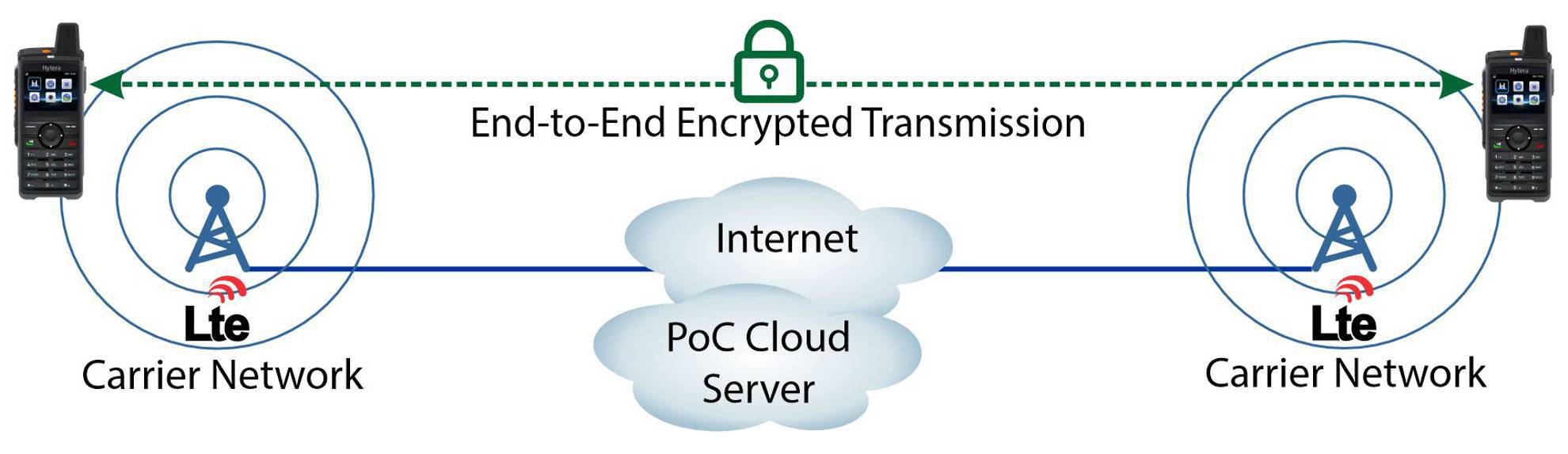
Shown below is an application diagram of an encrypted transmission transported from one PoC radio to another across an LTE carrier network to the internet and the PoC Cloud Server and then again to the carrier LTE network. Encryption and decryption only takes place at the radios or the PoC Cloud Server.
Hytera PoC radios provide additional security with the ability of a dispatcher to stun (disable) a radio that has been lost or stolen to prevent unauthorized users from listening to calls on the network.
How Encryption Works with DMR Radio Systems
Hytera DMR radios and repeaters are available with basic encryption that provides private conversations, but not maximum security. Advanced AES Encryption is available on Hytera DMR radios with the purchase of an encryption license. Here is a step-by-step explanation of how AES encryption works in DMR radios:
Voice/Data Input – When a user speaks into a DMR radio or sends data, the analog signals (voice) are converted into digital signals using a vocoder.
Key Generation – A cryptographic key is generated. This key is a random sequence of bits used to encrypt and decrypt the data.
Encryption Process – The digital signals are then passed through the AES encryption algorithm which uses the cryptographic key to transform the digital signal into an encrypted format.
Transmission – The encrypted signal is transmitted over the air. To any interceptor, the signal appears as random noise or unintelligible data. The encrypted data can be passed through the radio repeater and any IP network used on the DMR system.
Reception – The receiving DMR radio captures the encrypted signal and uses the same encryption algorithm along with the cryptographic key to decrypt the signal back into its original digital form.
Digital to Analog Conversion – Finally, the digital signals are converted back into analog signals for the end user to hear or receive the data in its original form.
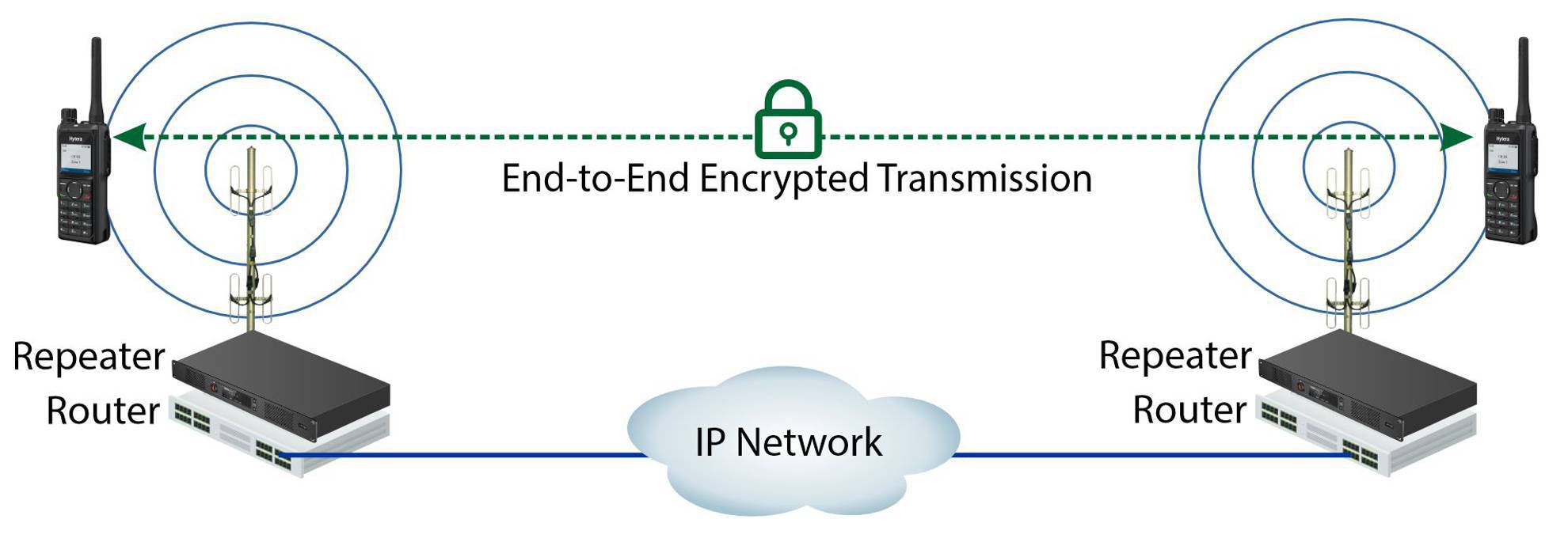
Shown below is an application diagram of an encrypted transmission transported from one repeater site to another over an TCP/IP network using a system called IP-Connect. This system is shown because it demonstrates how different repeater locations can extend network range and make calls over a TCP/IP network, and how encryption secures the communications from end to end, including the TCP/IP network path. Encryption and decryption only takes place at the radios or the repeaters.
Additional security features are available on DMR radios and radio systems. DMR radio systems like Hytera XPT and DMR Tier III support Radio Identification that only allows radios with a specific ID onto the radio system. DMR radios also support stun and revive which enables a dispatcher application to disable a radio that has been lost or stolen.
Benefits of Encryption for End Users
Security and Privacy – Encryption ensures that communications remain confidential. Unauthorized parties cannot eavesdrop on conversations, which is crucial for sensitive and critical communications.
Compliance – Many industries have regulatory requirements for communication security. Encryption helps organizations comply with these regulations, avoiding potential legal and financial repercussions.
Data Integrity – Encryption also protects data integrity by preventing unauthorized modifications. This is particularly important for transmitting critical data, such as GPS coordinates or text messages.
Peace of Mind – Knowing that communications are secure provides peace of mind for users. This is particularly valuable in high-stakes environments where secure communication can mean the difference between success and failure.
Protection Against Interference – Encrypted communications are less susceptible to intentional interference or jamming, ensuring reliable communication channels even in hostile environments.
Who Can Benefit from Encrypted Communications
Specialized Couriers – Encrypted radios protect the confidentiality of sensitive client information and delivery details, preventing data breaches. Secure communication allows couriers to receive real-time updates about delivery changes or traffic conditions without risking interception.
Hospitals – Encryption ensures patient privacy and compliance with regulations like HIPAA by protecting patient information during communication. Emergency Response teams use secure radios to facilitate quick, clear coordination between medical teams during emergencies, improving response times.
Cannabis Operations – Encrypted radios prevent theft and enhance security measures, protecting valuable inventory, securing the transportation and storage of large amounts of cash, and sensitive business information. Secure communications also help cannabis companies meet strict regulatory requirements for tracking and reporting.
Private Security Companies – Encrypted communication improves operational security by preventing eavesdropping, and ensuring security plans remain confidential. Secure radios allow for effective incident management with private coordination during incidents, maintaining client safety and security.
Armored Transport – Encrypted radios enable secure logistics by protecting sensitive information about routes and schedules, reducing the risk of theft. In case of an attack or emergency, secure crisis communication ensures quick coordination with law enforcement.
Casinos – Encrypted communication helps prevent fraud by securing information about surveillance and security measures. Secure radios ensure seamless coordination between security, management, and floor staff for improved operational efficiency.
Financial Institutions – Encryption ensures communication between branches and with central offices, protecting financial transactions and client data. Secure radios help meet regulatory requirements such as PCI-DSS (Payment Card Industry Data Security Standard) for safeguarding customer information.
Government and Public Safety – Ensures confidential communication during law enforcement operations, investigations, and emergencies, safeguarding sensitive information and strategies. Facilitates coordinated emergency response efforts between fire, police, and medical teams during crises, improving overall public safety.
Energy and Utilities – Secure radios help monitor and manage critical infrastructure like power grids and pipelines, preventing unauthorized access and potential disruptions. Ensures reliable communication during maintenance, emergencies, and natural disasters, facilitating prompt action and minimizing downtime.
Transportation and Logistics – Enhances security operations and logistical coordination at airports and ports, ensuring efficient handling of cargo and passenger safety. Secures communication in shipping and freight logistics chains, from warehouses to delivery trucks, ensuring on-time deliveries and inventory management.
Education – Ensures secure communication among security personnel, faculty, and administrators during emergencies and daily operations. Facilitates efficient communication for scheduling, events management, and student safety protocols.
Summary
Digital Mobile Radio (DMR) and Push-to-Talk over Cellular (PoC) technologies have transformed communication by integrating AES encryption for secure interactions. While analog systems used scrambling for basic privacy, modern digital encryption provides robust security for both individual and group communications. AES and ARC4 algorithms ensure the confidentiality and integrity of voice and data transmissions, including GPS data, across various networks. These technologies are essential in industries like specialized couriers, hospitals, cannabis operations, private security, armored transport, casinos, and more. They help meet regulatory compliance, protect sensitive information, and enhance operational efficiency. Encrypted radios offer peace of mind, ensuring reliable, interference-resistant communications, and are crucial for sectors requiring high-level security and privacy.
Contact Hytera to learn more about Hytera DMR Radios and Push-to-Talk over Cellular Radios.