How to Determine the IP Rating and MIL-STD Compliance You Need for Your Two-Way Radios
IP ratings and MIL-STD-810 tests measure different aspects of radio durability. An IP rating indicates how well a radio enclosure protects against dust and water, while MIL-STD-810 testing evaluates equipment under selected environmental conditions such as shock, vibration, temperature, humidity, dust, and rain. Neither one alone tells you how rugged a radio is for every application, so buyers should compare the individual product’s IP rating and documented MIL-STD-810 test methods with the conditions in which the radio will be used.
In order to determine how durable your radios need to be, you need to evaluate the operating environment in which they will be used. This article will help you understand the IP ratings and appropriate MIL-STD test performance you will require to ensure your radios withstand the conditions in your work environment.
What is MIL-STD-810?
MIL-STD-810 is a U.S. Department of Defense test-method standard for evaluating how equipment performs under environmental stresses such as temperature, humidity, vibration, shock, dust, and rain. The standard does not assign one universal durability rating. Manufacturers select applicable test methods, procedures, and conditions based on the intended operating environment.
Low Temperature
High Temperature
Temperature Shock
Low Pressure
Impact Shock
Vibration
Salt Fog
Rain
Dust
Drop
Solar Radiation
Humidity
When selecting a rugged two-way radio, make sure it is tested to applicable MIL-STD-810 methods rather than relying on a claim that it was “designed to meet” the standard.
Deciding whether you need radios tested to MIL-STD-810 methods is easy. Many Hytera DMR Two-Way radiosandPush-to-Talk over Cellular (PoC) radios are tested to applicable MIL-STD-810G or MIL-STD-810H environmental methods. Depending on the model, documented tests may evaluate conditions such as shock, vibration, humidity, and temperature extremes.
IP Ratings
IEC 60529 is formally titled Degrees of protection provided by enclosures (IP Code) and defines classifications for enclosure protection.
IP ratings classify how well an electrical enclosure protects against access, solid foreign objects, dust, and water. The IP Code is defined by IEC 60529. For two-way radios, the familiar two-digit ratings such as IP54, IP67, and IP68 indicate the tested level of protection provided by the radio enclosure.
The numerals identify specific levels and types of protection. They should be interpreted according to the individual test requirements because a higher water-protection numeral does not necessarily mean the enclosure has passed every lower-number water test.
All Hytera radios, designed for professional and commercial purposes, are subjected to rigorous testing to determine their IP rating.
Dust and Dirt Ingress
Hytera manufactures dirt and dustproof radios for those that work in harsh and occasionally dirty conditions. Dust and debris can obstruct speaker and microphone openings or enter insufficiently protected enclosures, potentially affecting radio performance. Radios used in dusty environments should have an IP rating appropriate for the expected level of particulate exposure.
The first IP digit indicates how well the design resists foreign materials getting into a device:
IP Level
Description
0
No special protection
1
Protected against objects greater than 50 mm in diameter
2
Protected against objects greater than 12.5 mm in diameter
3
Protected against objects greater than 2.5 mm in diameter (tools or thick wires)
4
Protected against objects larger than 1 mm (wires or screws)
5
Dust-protected; limited dust ingress is permitted but cannot interfere with satisfactory operation
6
Dust-tight
Which IP Dust Ingress Level is Right for You?
Work Environment
Recommended IP Rating
Occasional dust, or work with small particles (metal shavings, small assembly parts)
4 or higher
Consistent presence of dirt and dust, such as construction, manufacturing, agriculture, cleaning services, and mining
5 or higher
Water Ingress
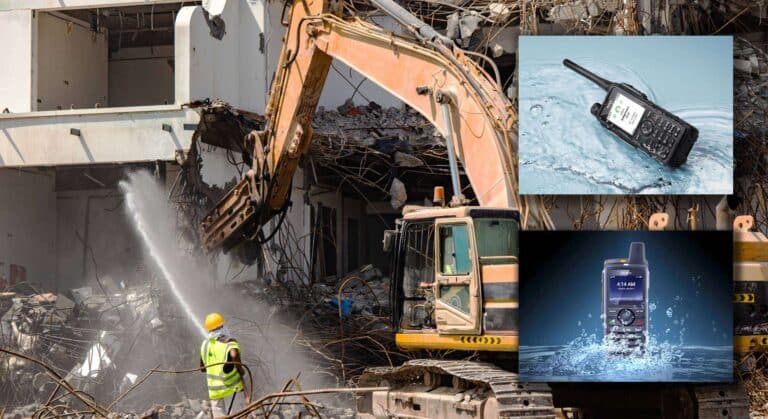
Radios used outdoors or near standing water may be exposed to rain, splashes, water jets, or accidental immersion. The appropriate IP rating depends on the type and severity of that exposure. A radio rated for splashing water is not necessarily rated for immersion, so buyers should match the individual product rating to the expected operating conditions.
The second IP digit shows resistance to water ingress:
Level
Description
0
None
1
Protected against dripping water (vertically falling drops)
2
Protected against dripping water (when tilted at 15 degrees)
3
Protected against spraying water (at any angle up to 60 degrees)
4
Protected against splashing water
5
Protected against low-pressure water jets
6
Protected against powerful water jets
7
Protected against immersion for up to 30 minutes at a depth of one meter
8
Protected against continuous immersion at a depth of 1.5 meters or greater (Hytera has successfully tested immersion for 4 hours at a depth of 2 meters)
Note: Liquid ingress testing refers to freshwater only. The IPx8 rating of depth and time of submersion can be specified by the manufacturer and must be greater than the IPx7 rating.
Which IP Water Ingress Level is Right for You?
Work Environment
Recommended IP Rating
Occasional exposure to falling water, rain or spills
IPX4
Consistent presence of spraying water, such as construction, manufacturing, agriculture, cleaning services, and mining
IPX5 or IPX6
Temporary or prolonged immersion, high temperature water jets
IPX7, IPX8, or IPX9
Hytera IP-Rated Two-Way Radios
With Hytera, you can be guaranteed that your radio will always provide a base level of water and dust protection, as all devices achieve at least an IP54 rating.
Where equipment is operated outdoors or in more challenging industrial environments, our premium radios achieve some of the highest IP ratings in the industry, protecting against full water submersion at 2 meters for up to 4 hours.
What Does Your Working Environment Require?
Indoor environments with limited exposure to dust and water may be well served by an IP54-rated radio, while applications in Construction, Manufacturing and Industry, Logistics and Transportation, or outdoor Facility Management may require greater protection.
Consider exposure to dust, rain, cleaning processes, standing water, accidental drops, vibration, temperature, and other environmental conditions when selecting a radio. Match those risks to the individual product’s IP rating and documented MIL-STD-810 test performance.
Contact Hytera to learn more about IP-Rated and MIL-STD two-way radios.