
Connecting PoC to Existing Radio Systems

Push-to-Talk over Cellular can connect to existing DMR and analog radio systems using a Radio over IP gateway or bridge. Hytera BRIDGE provides a compact hardware interconnect that links Hytera PoC radios with DMR or analog radio users. This allows organizations to add wide-area PoC communication for service teams, fleets, remote workers, and other locations while preserving their existing radio system investment.
What is a PoC Radio Bridge?
A PoC radio bridge is a gateway between broadband PoC communication and traditional narrowband radio communication. It allows users on PoC radios to talk with users on DMR or analog radios through a controlled interconnect.
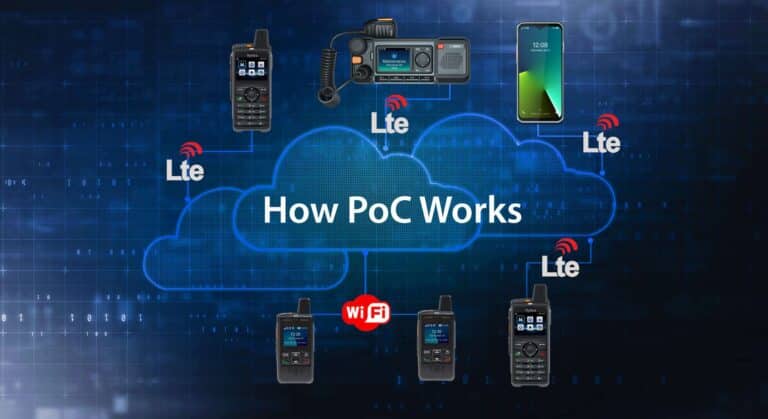
PoC radios communicate over 4G/LTE and 5G cellular networks or Wi-Fi. Traditional DMR and analog radios communicate over licensed UHF or VHF narrowband frequencies, often through repeaters. A bridge connects these two environments so communication can pass between them.
This is useful for organizations that already have a reliable local radio system but need to extend communication beyond the normal coverage area. Instead of replacing every radio or rebuilding the entire system, the organization can add PoC for users who need wide-area coverage.
What is Hytera BRIDGE?
Hytera BRIDGE is a Radio over IP gateway that connects Hytera Push-to-Talk over Cellular radios with DMR and analog radio systems. It is designed as a simple, reliable, and cost-effective way to add PoC calling to existing radio systems.
Hytera BRIDGE can enable group radio calling between Hytera PoC radios and analog radios, DMR Tier II conventional radio systems, Hytera XPT systems, or DMR Tier III trunking systems. It is especially useful when an organization wants to keep using its current local radio system while adding PoC radios for wide-area users.
The key value is flexibility. A business can continue using DMR or analog radios for on-site coverage while using PoC radios for employees, vehicles, contractors, managers, or remote teams that operate outside the local radio coverage area.
How Does the PoC Bridge Work?
In a typical bridging application, the system uses a special hardware configuration that interconnects and re-broadcasts communication between a PoC mobile radio and a DMR mobile radio.
The PoC mobile radio provides connectivity to Hytera PoC radios through 4G/LTE and 5G cellular networks or Wi-Fi internet access. The DMR mobile radio provides connectivity to DMR or analog radios and repeaters through narrowband UHF or VHF radio frequencies.
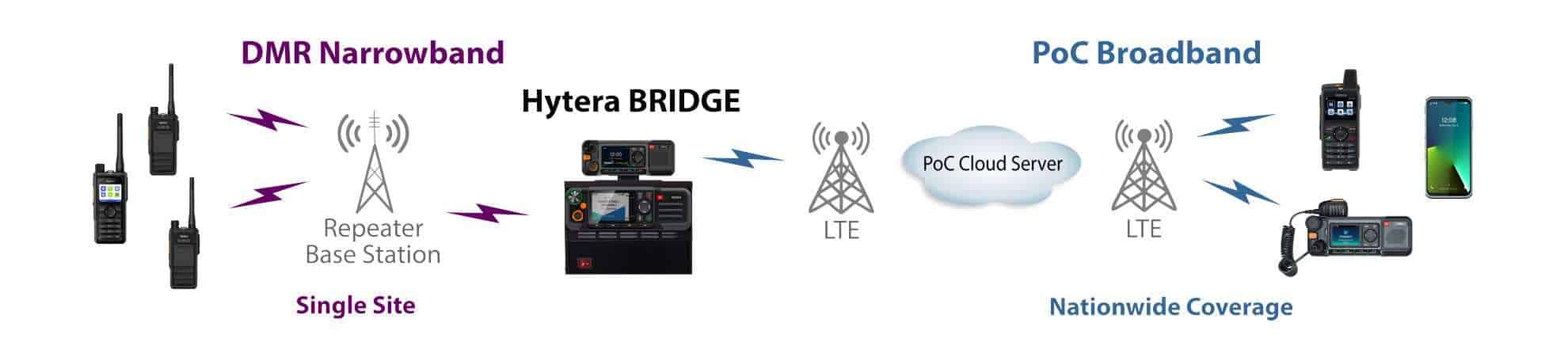
When a PoC user talks, the PoC mobile radio receives the communication and passes it through the bridge to the DMR or analog mobile radio. That radio then transmits the audio into the local radio system. When a DMR or analog user talks, the process works in the other direction. The DMR or analog mobile radio receives the audio and the bridge passes it to the PoC mobile radio, which sends it to the appropriate PoC users or talk group.
The result is a reliable and cost-effective interconnect between broadband PoC users and traditional radio users.
A Single-Channel or Multi-Channel Interconnect
Hytera BRIDGE provides a single-channel interconnect. This means one bridge links one radio channel or talk path between the PoC system and the connected radio system.
For many applications, one channel is enough. A business may only need to connect one operations channel, one security channel, one maintenance channel, or one fleet channel to PoC users.
If additional channels are needed, multiple bridges can be added. For example, one bridge could connect a security channel, another could connect a maintenance channel, and another could connect a transportation channel. This makes the bridge architecture scalable without requiring a complete replacement of the existing radio system.
Why Connect PoC to an Existing Radio System?
Many organizations already have radio systems that work well for local coverage. A school, warehouse, hotel, hospital, factory, construction site, or security operation may have DMR or analog radios that cover the property effectively.
The problem appears when users leave that coverage area.
A DMR system may work well on campus but not reach school buses across the district. A warehouse radio system may cover the building but not supervisors driving between locations. A security radio system may cover a venue but not mobile patrols across town. A manufacturing site may cover the plant but not service teams, delivery vehicles, or remote facilities.
PoC solves that wide-area coverage problem. The bridge lets the organization add PoC without abandoning the local radio system.
Application Example: Single Site with Wide-Area Fleet Vehicles
A facility may already use DMR radios for maintenance, security, and operations inside one location. The system works well on site, but now field service employees need to communicate from outside the facility, or there is a vehicle fleet that needs to communicate with a dispatcher.
Fleets often move beyond the reach of a local repeater. A shuttle, delivery vehicle, school bus, service truck, or security patrol vehicle may need to speak with on-site staff while operating across a city or region.
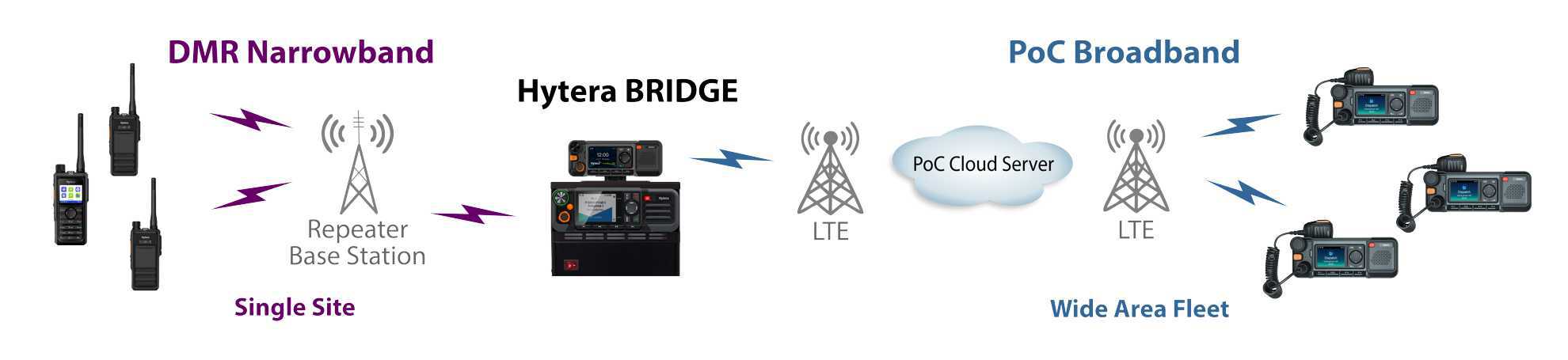
A bridge can connect the fleet’s PoC radios or mobile PoC radios to the existing on-site radio channel. Drivers communicate through PoC over 4G/LTE and 5G cellular networks, while the facility team continues using DMR or analog radios.
This can be more practical than trying to extend a traditional radio system across every route, road, and service area. It also lets the organization use vehicle-friendly PoC mobile radios for drivers while keeping existing handheld radios for on-site staff.
Examples include:
- Service technicians working at customer locations
- Maintenance teams traveling to supply houses or remote buildings
- Student transportation services outside of a campus
- Security supervisors moving between properties
- Drivers or fleet vehicles outside radio coverage
With a bridge, the on-site DMR users continue using their existing radios. The wide-area users use PoC mobile radios in their vehicles. When a PoC user calls the connected group, the audio is re-broadcast into the local radio system. When an on-site radio user replies, the audio is routed back to the PoC group.
This gives the organization an “and both” strategy: keep the local DMR system where it works well and add PoC where broader coverage is needed.
Application Example: Connecting Remote Locations
Some organizations have multiple DMR Tier II repeater sites and they need connectivity for calls between these remote locations.
Hytera BRIDGE can provide connectivity between remote radio networks over PoC broadband access. In this type of design, each site can keep its local radio coverage while the bridge provides a communication path between locations.
For example, a company may have a main facility and a remote warehouse. Each location uses DMR radios locally. A bridge can connect selected communication between the sites so users at one location can reach users at the other without changing the entire system architecture.
DMR IP Site Connect is a traditional way to link multiple DMR Tier II repeater sites over an IP network. It is often used when organizations need radio communication across campuses, remote facilities, or geographically separated locations.
A PoC bridge can support a similar operational goal in a different way. Instead of building a full multi-site DMR IP Connect network, the organization can use bridges to connect selected DMR channels through PoC broadband access.
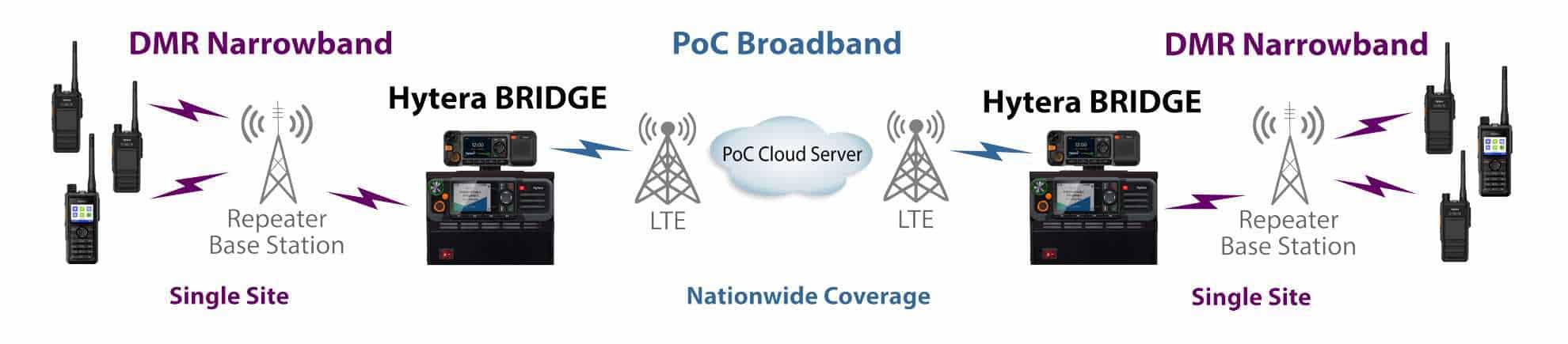
This is useful when a business needs targeted interconnection rather than a full multi-site repeater network. For example, a school district may want one district-wide operations path between campuses. A manufacturing company may want one shared channel between a plant, warehouse, and administration office. A property management company may want maintenance teams at different sites to reach a central operations channel.
It is important to understand the difference. A bridge is a single-channel RoIP interconnect. A full DMR IP Site Connect system carries DMR traffic between repeaters over an IP network. The bridge approach is useful when the goal is simple, cost-effective channel interconnection, not a complete replacement for a multi-site DMR system.
Application Example: School Resource Officer Carrying Two Radios
Some school resource officers carry two radios: one radio for the school’s DMR system and another radio for the local police department’s P25 system. This can be inconvenient because the officer has to manage two devices, two chargers, two accessories, and two separate communication workflows.
A bridging strategy can simplify this type of use case when the required permissions, technical compatibility, and agency approvals are in place.
For example, one bridge could connect the school’s DMR radio system to a PoC channel. A second approved bridge or interconnect could connect the public safety radio system to a separate PoC channel. The school resource officer could then carry one PoC radio and change channels on the PoC device to communicate with the school system or the public safety system.
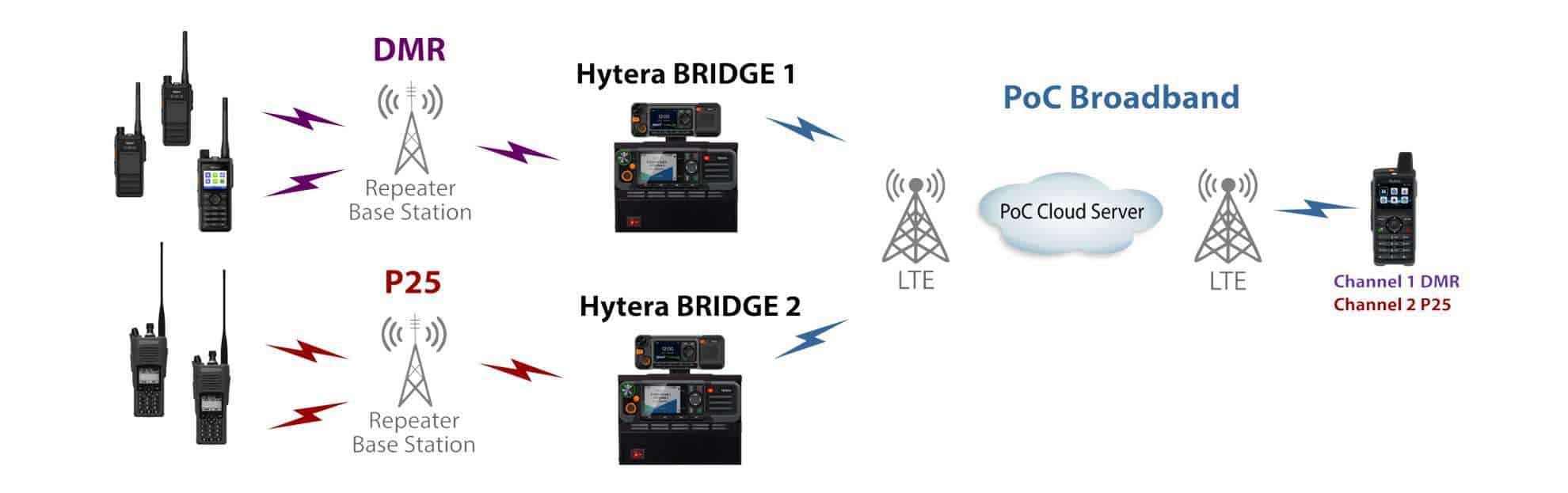
This approach must be planned carefully. Public safety systems such as P25 networks are controlled systems with strict authorization, security, governance, and interoperability requirements. Any connection to a police or public safety radio system should be approved by the agency that owns the system and implemented by qualified radio professionals.
The operational benefit is clear: one device can give the officer access to the right communication path, while each radio system remains separate and controlled.
Key Benefits of Connecting PoC to Existing Radio Systems
Connecting PoC to existing radio systems can provide several benefits:
- Extends communication to users outside local radio coverage
- Preserves investments in DMR and analog systems
- Adds wide-area PoC communication without replacing every radio
- Connects service teams, fleets, and remote users to on-site staff
- Supports simple single-channel interconnects
- Allows multiple bridges for additional channels
- Provides a migration path from traditional radio to PoC
- Helps connect remote sites without building a full new radio network
- Gives organizations flexibility to use the right technology in the right place
The most important benefit is continuity. Employees can keep using familiar radios and channels while the organization adds PoC where it solves real coverage and mobility problems.
When Should an Organization Use a PoC Bridge?
A PoC bridge is a good fit when an organization has a working local radio system but needs broader coverage for some users.
It is especially useful for:
- Schools with buses or school resource officers
- Security companies with mobile patrols
- Warehouses with delivery vehicles
- Hotels and resorts with remote facilities or transportation
- Manufacturing companies with multiple buildings or nearby sites
- Construction companies with field supervisors
- Hospitals with parking, shuttle, or off-site teams
- Property management companies with multiple locations
- Businesses migrating gradually from analog or DMR to PoC
A bridge is not always the right solution for every system. If an organization needs many channels, heavy traffic capacity, advanced trunking, or full multi-site radio networking, a more comprehensive DMR or company-wide PoC system design may be appropriate. But for many single-channel and targeted interconnect applications, a PoC bridge is an efficient way to extend communication.
Conclusion
Connecting PoC to existing radio systems gives organizations a practical way to expand coverage without abandoning the radios and infrastructure they already use. Hytera BRIDGE provides a compact RoIP gateway that links Hytera PoC radios with DMR and analog radio systems through a single-channel interconnect.
The bridge uses a PoC mobile radio for broadband connectivity over 4G/LTE and 5G cellular networks or Wi-Fi, and a DMR mobile radio for narrowband UHF or VHF communication with radios and repeaters. This creates a controlled path between PoC users and traditional radio users.
For many organizations, this is the best of both systems: DMR or analog radios for reliable local site communication, and PoC radios for wide-area users, fleets, service teams, remote locations, and cross-site communication.
Frequently Asked Questions
Yes. PoC can connect to DMR radios through a Radio over IP bridge such as Hytera BRIDGE. The bridge allows Hytera PoC radios to communicate with users on DMR radio systems.
Yes. Hytera BRIDGE can connect Hytera PoC radios with analog radio systems, allowing organizations to add wide-area PoC communication while keeping existing analog radios in use.
Hytera BRIDGE is a compact RoIP gateway that connects Hytera Push-to-Talk over Cellular radios with DMR and analog radio systems. It provides a single-channel interconnect between broadband PoC users and traditional radio users.
A PoC to DMR bridge uses a PoC mobile radio for broadband connectivity and a DMR mobile radio for narrowband radio connectivity. The system interconnects and re-broadcasts communication between PoC radios and DMR or analog radios.
Each Hytera BRIDGE provides a single-channel interconnect. If more channels are needed, multiple bridge systems can be deployed.
A business may connect PoC to an existing radio system to extend communication to mobile workers, fleets, remote locations, or service teams without replacing the local DMR or analog radio system.
Yes. A PoC bridge can help connect selected communication between remote radio networks over PoC broadband access. For full DMR repeater networking, DMR IP Site Connect may also be considered.
No. A PoC bridge is a single-channel RoIP interconnect between PoC and traditional radio systems. DMR IP Site Connect links multiple DMR Tier II repeater sites over an IP network and is designed for multi-site DMR repeater networking.
In some approved system designs, yes. A school resource officer could use one PoC radio with separate channels connected to different radio systems, such as a school DMR system and an approved public safety interconnect, subject to agency authorization, compatibility, and proper system design.
A PoC bridge should be designed and installed by an authorized radio dealer or qualified radio system integrator. The installer should confirm compatibility, licensing, channel use, audio levels, permissions, and system configuration before deployment.