
What Is the Range of a DMR Two-Way Radio?

Two-way radio range depends on the frequency, radio power, antenna, terrain, building materials, interference, and whether the system uses repeaters. As a practical planning range, direct radio-to-radio communication may cover about 1 to 5 miles in favorable open conditions, but can be much shorter indoors. A DMR repeater system may support about 30 to 50 miles radio-to-repeater-to-radio under favorable conditions, with each repeater site creating its own coverage area. Connecting multiple repeater sites in groups can extend range even further, and DMR Tier III networks can cover hundreds of miles.
How does the DMR Radio Standard Extend Range?
DMR digital technology reduces noise and preserves voice quality over a greater range than analog radios, especially at the farthest edges of the transmission range. One of the reasons that DMR has an excellent range performance is the Forward Error Correction (FEC) and Cyclic Redundancy Check (CRC) coders specified in the DMR standard. These coders enable receiving radios to detect and correct transmission errors by analyzing bits inserted into messages that allow the receiving radio to tell if there is an error.
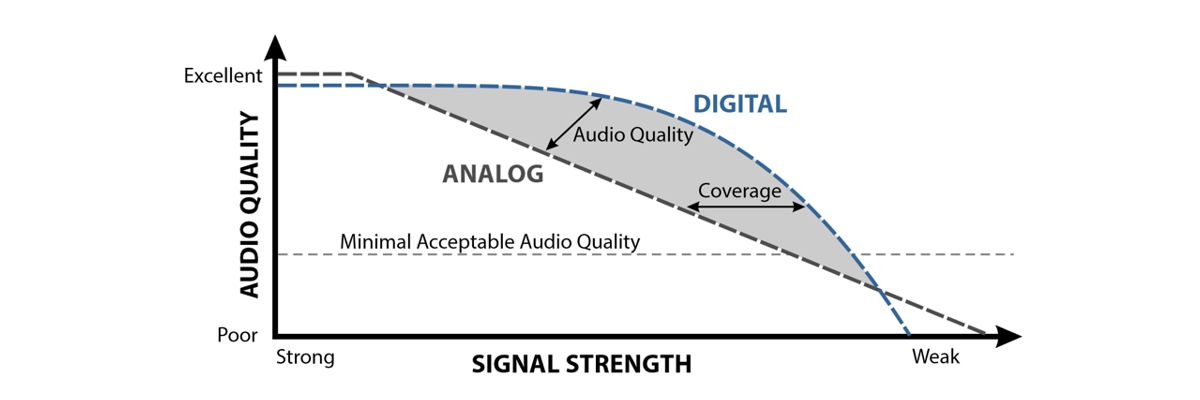
Using coders and other techniques, digital processing can screen out noise and reconstruct signals from degraded transmissions. The result is an increase in the radio system’s effective range where users can hear everything being said more clearly over longer distances.
What is the Range of a DMR Radio?
Unfortunately, the most accurate answer is: it depends.
There are a lot of long-distance claims from different companies about the range of two-way radios. These are best-case scenarios over flat land, and they do not represent the actual range experienced by the typical user. The most reliable estimates for radio range to use for radio system planning should be based on the actual terrain of the coverage area and not an overly optimistic best guess.
For business users, the better question is not simply, “How many miles will this radio reach?” The better question is: What coverage area does my team need, and what system design will reliably cover that area?
As a general planning framework in real-world applications:
- Radio-to-radio range: about 1 to 5 miles in favorable open conditions, often much less indoors or around heavy obstructions.
- DMR repeater range: about 30 to 50 miles total radio-to-repeater-to-radio in favorable conditions.
- Repeater coverage radius: commonly planned around the coverage area of each repeater site, with a tower or elevated antenna potentially supporting communication up to roughly 25 miles from the repeater under favorable flat-land conditions.
- Multi-site systems: IP Connect and XPT can group multiple repeater coverage areas together over IP networks.
- Wide-area trunking: DMR Tier III systems can cover cities, multiple counties, or larger regions depending on the number of sites, towers, frequencies, and infrastructure.
These numbers are not guarantees. They are planning ranges. Real-world coverage should be confirmed with a site survey and professional system design.
What Affects Two-Way Radio Range?
Two-way radio range is shaped by both the radio equipment and the environment. Some factors are controlled by the system designer, such as antenna placement, repeater infrastructure, and frequency selection. Others are site conditions, such as hills, buildings, walls, trees, machinery, vehicles, and interference.
The most important range variables include:
- UHF or VHF frequency selection
- Obstacles such as buildings, hills, walls, trees, and terrain
- Radio transmit power and receiver sensitivity
- Antenna gain and antenna height
- Interference from nearby radio systems or equipment
- Whether users are communicating radio-to-radio or through repeaters
- System infrastructure and professional installation
No single feature controls range by itself. Coverage is the result of how the radios, frequency, antenna system, repeater infrastructure, and environment work together.
UHF vs. VHF Frequencies
Two-way radios commonly use UHF or VHF frequencies. Both can be effective, but they behave differently.
VHF radio frequencies are often useful in open outdoor areas with fewer obstructions. VHF signals can perform well across open land, agricultural sites, marine environments, and other locations where the signal has a clearer path.
UHF radio frequencies are often preferred in built environments because they can perform better around buildings, walls, shelving, equipment, vehicles, and other obstacles. This is why UHF is commonly used in warehouses, schools, hotels, manufacturing plants, retail facilities, business campuses, and other dense environments.
The right frequency band depends on the site. A large open property may benefit from VHF. A dense building or industrial facility may benefit from UHF. A radio dealer or system integrator can help determine which frequency band is appropriate for the site, license, and system design.
Obstacles Are Usually the Biggest Range Factor
Obstacles are often the primary reason two-way radios do not reach as far as users expect.
Radio signals travel best with line of sight. Line of sight does not always mean users must physically see each other, but it does mean the signal performs better when there are fewer barriers between radios or between a radio and a repeater antenna.
Common range-limiting obstacles include:
- Concrete walls
- Metal buildings
- Hills and mountains
- Dense trees
- Elevators and stairwells
- Underground areas
- Large machinery
- Vehicles and shipping containers
- Warehousing racks and inventory
- Multi-story building structures
Open land, flat terrain, and water can allow radio signals to travel farther because there are fewer obstructions. Dense buildings can shorten usable range dramatically. In some cases, thick concrete walls, below-ground areas, or metal structures can reduce coverage to a few hundred feet without the right system design.
That is why “up to X miles” claims should be treated carefully. Those numbers usually describe favorable open-area conditions, not the expected range inside a real building, campus, or industrial site.
The Radios Matter Too
The radio itself also affects communication range.
Important radio-related factors include:
- Transmit power: Higher transmit power can help a signal travel farther, but power alone does not solve every coverage challenge. Obstacles, antenna design, frequency selection, and infrastructure still matter.
- Receiver sensitivity: A radio with strong receiver sensitivity can better detect weaker signals, which can improve communication near the edge of the coverage area.
- Antenna design: Antenna quality, gain, length, placement, and condition all affect performance. A damaged or mismatched antenna can reduce range.
- Signal attenuation: Attenuation is the weakening of a signal as it passes through air, walls, equipment, vehicles, or other materials.
- Battery condition: A weak or aging battery may affect radio performance, especially if the radio cannot sustain normal transmit operation.
- Frequency programming and licensing: Radios must be properly programmed and used on appropriate licensed or authorized frequencies. Poor programming or interference from nearby users can reduce effective communication.
A better handheld radio can help improve performance, but a better radio cannot overcome every site problem. In larger or more complex environments, system infrastructure becomes the key to dependable coverage.
Radio-to-Radio Range
Radio-to-radio communication is the simplest form of two-way radio operation. One radio transmits directly to another radio without a repeater.
This type of communication may also be called direct mode, simplex, or talkaround, depending on the system and programming.
As a practical planning range, radio-to-radio DMR communication may cover about 1 to 5 miles in favorable open conditions. In real-world business environments, that range can be much shorter. Inside dense buildings, below-ground areas, concrete structures, metal facilities, or large warehouses, usable range may be limited to a section of a building, a floor, a yard, or even a few hundred feet in difficult coverage areas.
Radio-to-radio communication is often a good fit for:
- Small facilities
- Retail stores
- Restaurants
- Small hospitality properties
- Jobsite crews
- Short-range maintenance teams
- Small warehouses
- Teams that work within a defined local area
The major advantage of radio-to-radio communication is simplicity. There is no repeater infrastructure, antenna system, network equipment, or complex system design required for basic direct communication.
The limitations are coverage and call capacity. A radio-to-radio system depends entirely on the radios and the environment. As user count increases or teams spread across larger areas, direct communication may no longer provide the coverage or organization the business needs.
When a business needs more dependable coverage across a larger site, the next step is usually a repeater system.
Radio Range with Repeaters
A DMR Tier II conventional repeater and an antenna is one of the most common ways to extend two-way radio range.
A repeater receives a signal from a handheld or mobile radio and retransmits it at higher power from a better antenna location. Because repeater antennas are often mounted on rooftops, towers, hills, or elevated structures, they can reduce the number of obstacles between users and the antenna.
As a practical planning range, a DMR repeater system can support about 30 to 50 miles total radio-to-repeater-to-radio communication under favorable conditions. That total includes both sides of the communication path.
For example:
- Radio User A may be 5 miles from the repeater.
- Radio User B may be 30 miles from the repeater.
- The total radio-to-repeater-to-radio path is about 35 miles.
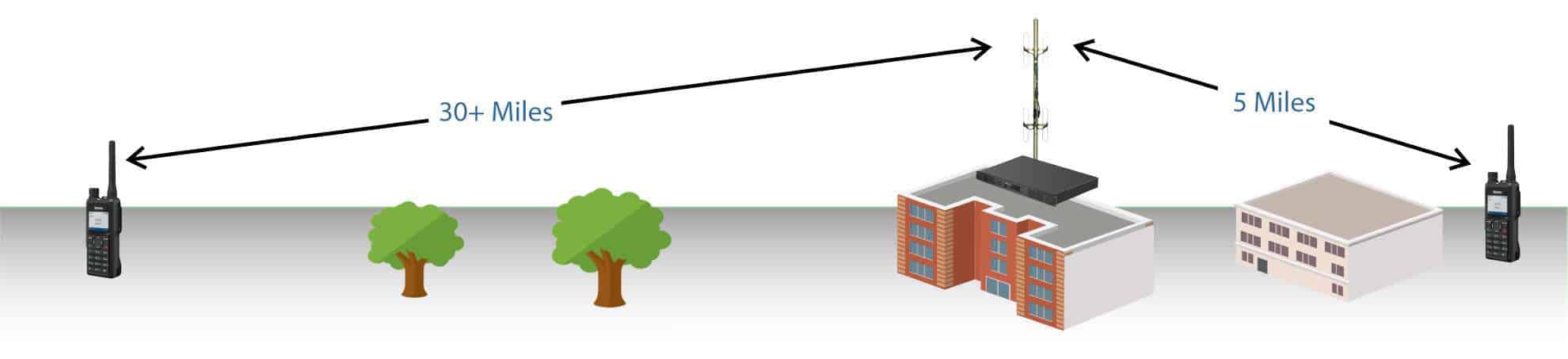
In another favorable flat-land scenario, a repeater antenna on a tower may support communication up to roughly 25 miles from the repeater site. That means the repeater site creates a local coverage radius, and users inside that coverage area can communicate through the repeater.
This does not mean every repeater system covers 25 miles in every direction. Indoor facilities, hilly terrain, dense cities, metal buildings, low antenna height, interference, trees, and concrete structures can reduce the coverage radius. Open terrain, good antenna height, professional installation, and proper frequency selection can improve it.
Extending Range By Connecting Multiple Repeater Sites
A single repeater site creates one designed coverage area. Some organizations only need one coverage area. Others need to connect several coverage areas. That is where systems like IP Connect and XPT become useful.
IP Connect links multiple DMR Tier II repeater sites over an IP network. Each repeater site provides its own local coverage radius, and the IP network connects those coverage areas allowing users at one site to communicate with users at another site through programmed channels or talk groups. XPT can also connect multiple repeater sites over an IP network, but it adds a different benefit: increased group calling capacity.
IP Connect is primarily used to connect coverage areas. XPT is used when organizations need both connected coverage areas and more efficient use of multiple repeaters for group communication.
Repeater Site Coverage Islands
If the facilities are far apart, those coverage areas are like separate coverage islands. The radio system connects the islands, but it does not necessarily provide continuous coverage between them.
For example, a company may have:
- A manufacturing facility on one side of town
- A corporate office several miles away
- A warehouse or logistics center in another location
A user at the manufacturing facility can call the warehouse, but a vehicle driving between those sites may lose radio coverage in the areas where no repeater site reaches.
This is an important distinction:
IP Connect and XPT connect repeater sites. They do not automatically fill every mile between them.
To create continuous coverage between locations, the system needs overlapping repeater coverage or additional repeater sites along the route.
Grouping Repeater Site Coverage
When repeater sites are closer together, their coverage areas may overlap. With the right system design, users can move between repeater sites while maintaining communication. This is called roaming.
Roaming allows a radio to switch from one repeater site to another as the user moves through the system. This can be valuable for users in vehicles or teams that move across a large connected area.
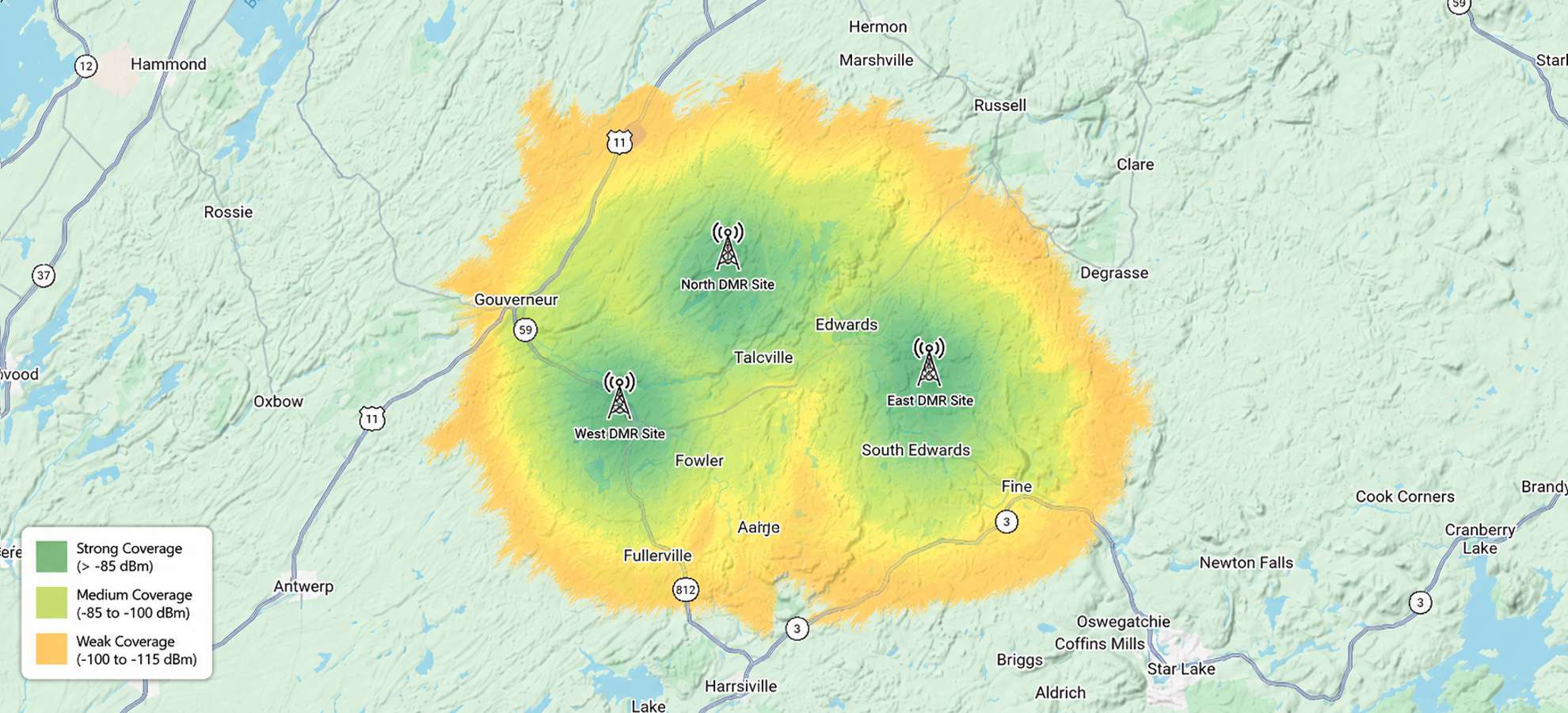
For example, a school district may install repeaters and antennas at multiple school campuses. Each school creates a local repeater coverage area. If those areas overlap, radios can be programmed to roam between sites. This can help support communication across the school district and surrounding area, including buses traveling through the coverage zones.
The same idea can apply to:
- Business campuses
- Industrial parks
- Resorts
- Distribution networks
- Transportation hubs
- Utility facilities
- Large manufacturing complexes
Roaming requires careful planning. Repeater sites, frequencies, antenna locations, coverage overlap, radio programming, and system settings must be coordinated.
DMR Tier III and Long Range Coverage
Wide-area radio networks are typically built using DMR Tier III systems, and are called a Specialized Mobile Radio Network or SMR network. DMR Tier III systems use extensive radio and IP network infrastructure with multiple antenna towers using different frequencies that can cover cities, metro areas, large regions, and even entire states. These systems are typically used when an organization or network operator needs wide-area coverage, high call capacity, centralized control, radio registration, call priority, dispatching, and advanced system management.
Some large companies have their own DMR Tier III networks, but they are usually built as SMR networks that are owned by large radio dealers and private radio network operators that lease access to the network. These SMR customers include school districts, security companies, ambulance companies, and distribution companies with large fleets.
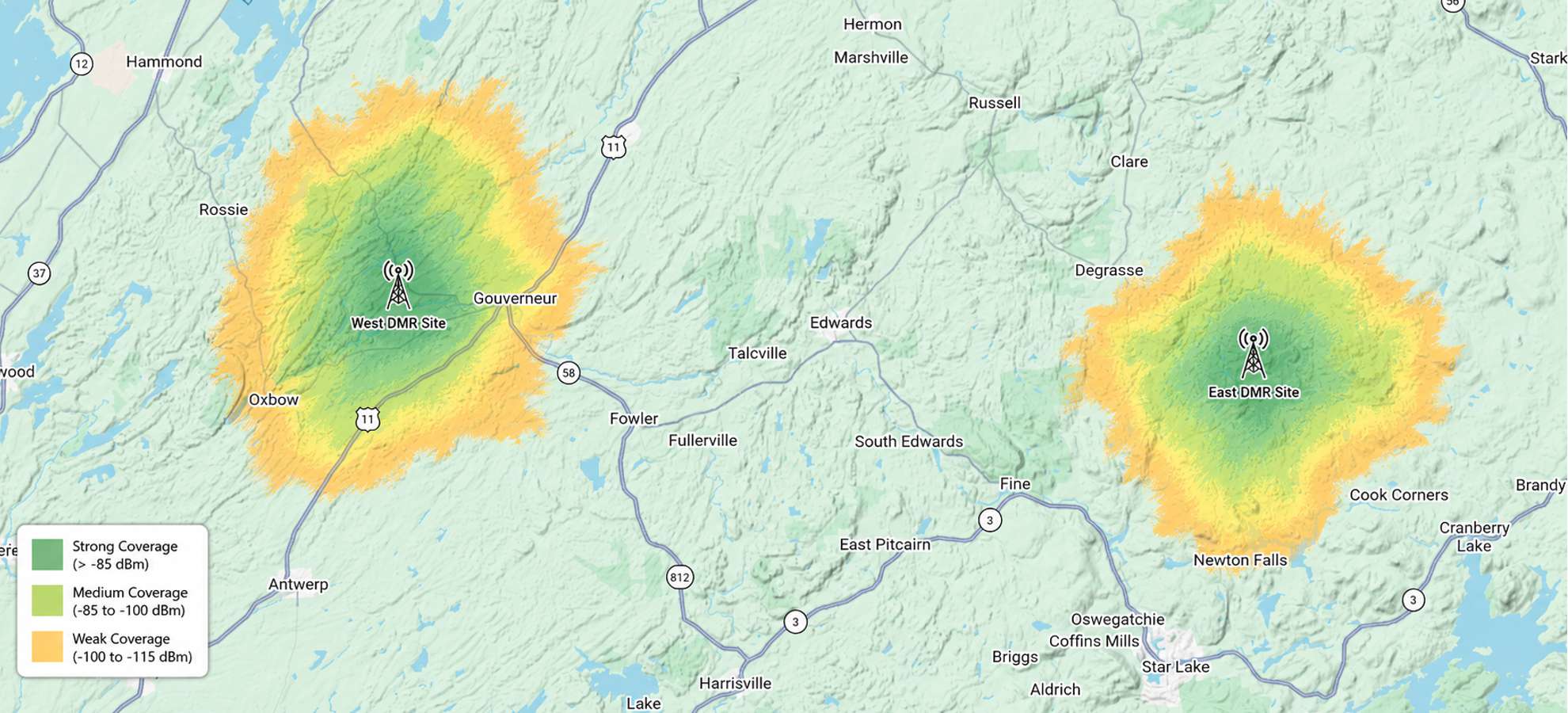
The following image shows the coverage area of an actual wide-area DMR Tier III SMR two-way radio network in Eastern New York provided by A1 Communications. This network provides coverage to highway departments in local towns, waste and recycling companies, school districts, and field services companies.
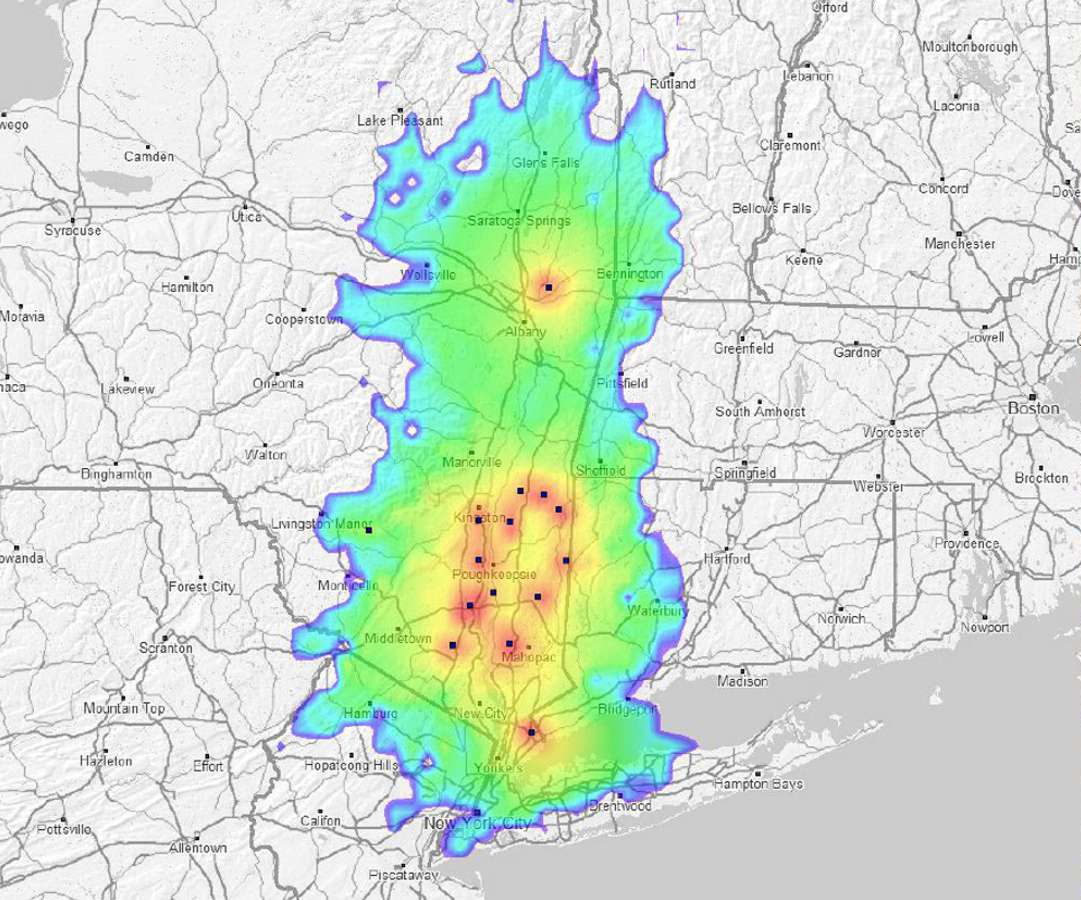
DMR Tier III is not the right fit for every business. It requires more infrastructure, planning, licensing, and system management than a single repeater site. But for large organizations or commercial radio network operators, it can provide a scalable path for wide-area professional radio communication.
Coverage Planning Examples
Example 1: Radio Range for Small Business or Retail Location
A small retail store, small business, or compact facility may only need radio-to-radio communication. In this case, the working range may be measured by the building layout rather than miles.
A practical expectation may be local coverage across the store, back office, stockroom, and nearby exterior areas, depending on building materials and interference.
Example 2: Radio Range for a Manufacturing Facility
A manufacturing facility may need a DMR Tier II repeater system because machinery, concrete walls, metal structures, and large indoor spaces can limit direct radio-to-radio range.
A repeater with an elevated antenna can help create a designed coverage area across the production floor, maintenance shop, offices, loading docks, and yard.
Example 3: Radio Range for a Company with Several Locations
A company with a manufacturing facility, corporate office, and warehouse in different locations may use IP Connect.
Each location has its own repeater coverage radius. IP Connect groups those coverage areas together so employees at one location can call teams at another location. If the sites are far apart, they operate like connected coverage islands.
Example 4: Radio Range for a School District or Multi-Building Campus
A district or campus may use multiple repeater sites with overlapping coverage. Radios can roam between those sites when the system is properly designed.
This can help support mobile users, facilities teams, transportation routes, and staff moving between buildings or campuses.
Example 5: Radio Range with a Regional Wide-Area Network
A large organization or network operator may use DMR Tier III to connect many repeater sites into a wide-area trunked system. With enough sites, towers, and frequencies, these systems can cover cities, multiple counties, or broader regions.
The Bottom Line: Design the System Around the Coverage Requirement
Two-way radio range depends on the environment and the system design.
As a general planning reference:
- Radio-to-radio range: about 1 to 5 miles in favorable open conditions, often much less indoors.
- Repeater range: about 30 to 50 miles total radio-to-repeater-to-radio under favorable conditions.
- Repeater radius: potentially up to roughly 25 miles from the repeater site under favorable flat-land conditions.
- IP Connect and XPT: connect or group multiple repeater coverage areas over IP networks.
- DMR Tier III: can support wide-area coverage across cities, counties, or regions when designed with sufficient infrastructure.
The most reliable way to answer the range question is to define the required coverage area and have the system professionally evaluated.
A qualified DMR system dealer can conduct a site survey using test equipment, review the building or outdoor environment, evaluate frequency options, identify coverage challenges, and design a system that fits the organization’s actual communication needs.
For business users, range should not be guessed. It should be planned, tested, and designed.
Frequently Asked Questions
As a practical planning range, direct radio-to-radio communication may cover about 1 to 5 miles in favorable open conditions. Indoors or around heavy obstructions, range can be much shorter.
A DMR handheld radio may communicate about 1 to 5 miles radio-to-radio in favorable open conditions. In dense buildings, underground areas, or metal structures, usable range may be much shorter and should be tested on site.
A DMR repeater system may support about 30 to 50 miles total radio-to-repeater-to-radio communication under favorable conditions. Actual coverage depends on antenna height, terrain, buildings, interference, frequency selection, and system design.
Repeater coverage radius is the area around a repeater site where radios can communicate through that repeater. Under favorable flat-land conditions, a tower-mounted repeater antenna may support communication up to roughly 25 miles from the repeater site, but actual coverage varies.
IP Connect connects multiple DMR repeater sites over an IP network. It does not increase the physical radius of one repeater site. Instead, it groups multiple repeater coverage areas so users at different sites can communicate.
XPT can connect multiple repeater sites and improve group calling capacity, depending on system design. Like IP Connect, XPT does not create coverage where no repeater signal exists. Each repeater site still has its own coverage area.
Coverage islands are separate repeater coverage areas that are connected by an IP network. Users can communicate between sites, but there may be no continuous radio coverage between those sites unless additional repeaters or overlapping coverage areas are added.
Roaming allows a radio to switch between repeater sites as the user moves through overlapping coverage areas. It is useful for campuses, districts, business complexes, and mobile users who travel between connected sites.
Yes. Depending on the number of repeater sites, towers, frequencies, and system infrastructure, a DMR Tier III trunked system can cover cities, multiple counties, or larger regional areas.
No. Advertised range should be treated as a general reference, not a coverage guarantee. Businesses should rely on a site survey and professional system design to confirm coverage for their actual facility, campus, route, or service area.