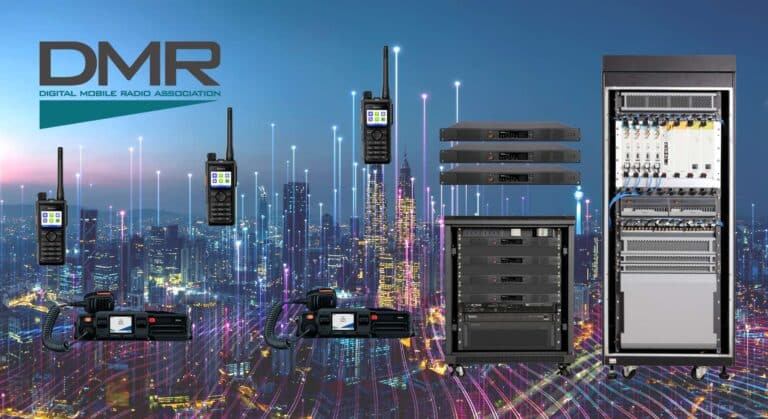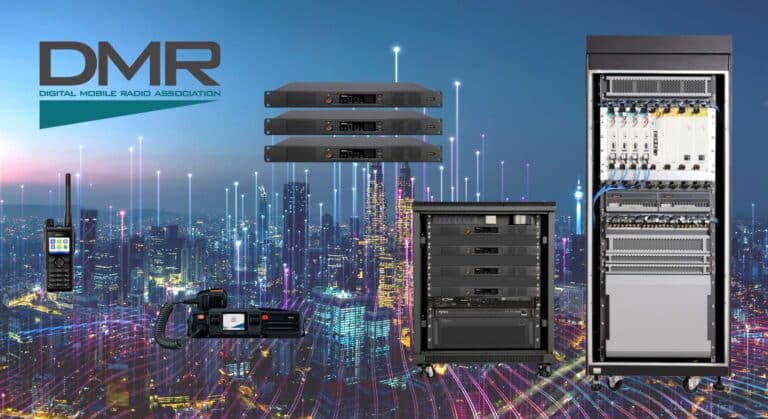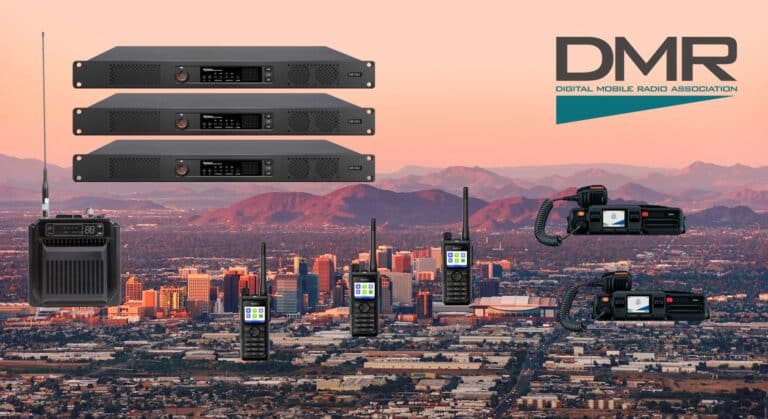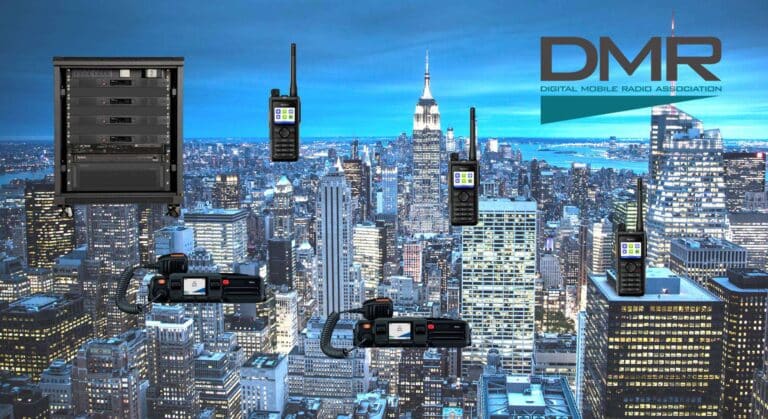

What are the Benefits of DMR Two-Way Radios?

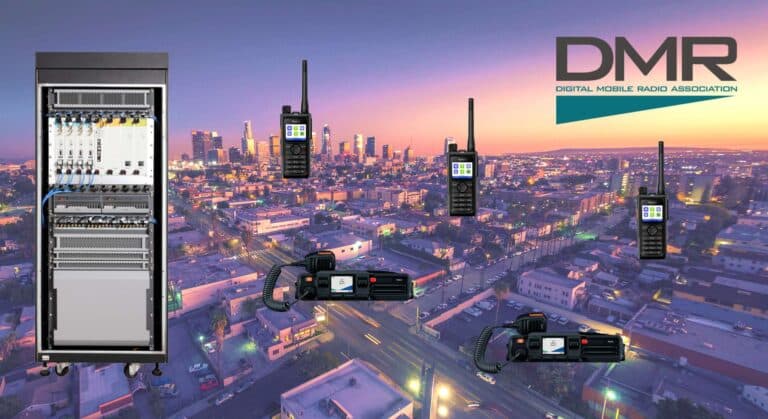
The DMR radio industry standard and DMR radio technology improves business two-way radio communications by delivering clearer digital audio, better spectrum efficiency, longer battery life, and a scalable upgrade path from analog systems. DMR uses two-slot TDMA to split a standard 12.5 kHz channel into two independent communication paths, effectively doubling call capacity without requiring additional spectrum licenses. It also supports digital data services such as text messaging, GPS location data, caller ID, emergency signaling, and dispatch integrations. For organizations with growing communication needs, DMR can start with simple radio-to-radio operation and expand to repeaters, IP Site Connect, XPT, or Tier III trunked systems.
DMR Radio Standard Overview
Digital Mobile Radio (DMR) is an open digital radio standard established by the European Telecommunications Standards Institute (ETSI) and promoted worldwide by the DMR Association. The DMR standard defines three tiers of capabilities that include simple radio-to-radio communications, repeater sites, and wide-area radio networks.
The DMR is a digital radio standard is used in professional two-way radios, and is supported by most radio manufacturers. Since DMR is widely available and standardized, it is the most cost-effective professional radio system available.
DMR offers numerous advantages over analog radio systems, such as improved voice clarity, better range, longer battery life, and increased calling capacity. It provides a seamless, cost-effective migration path from legacy analog systems to modern digital voice and data architecture without restricting buyers to a single proprietary brand.
Hytera was instrumental in the development of the DMR standard, and was the first company to deploy a fully compliant DMR Tier III radio system.
The Strategic Value of DMR Standards Compliance
Choosing open-standard DMR equipment ensures your organization builds its communications on a unified, vendor-agnostic foundation. Instead of being locked into a single manufacturer's closed system, standards-compliant networks allow long-term flexibility, hardware interoperability, and modular upgrades.
1. Interoperability & Vendor Flexibility
Because DMR is an open standard, compliant base stations, repeaters, and handheld radios from different manufacturers are designed to work together harmoniously. This prevents proprietary system lock-in, enabling phased migrations from legacy analog systems. Note: While core features interoperate, specialized capabilities such as advanced encryption variants, proprietary software integrations, or custom accessories, complete functionality should be verified prior to deployment.
2. Enhanced System Performance
Adhering to the DMR framework means your hardware utilizes uniform rules for digital voice encoding, signaling, and channel access. This guarantees consistent coverage, crisp background-noise cancellation, and reliable transport for metadata like caller ID or basic text messaging.
3. Seamless Future Scalability
A standards-based architecture safeguards your initial investment. A business can easily deploy simple radio-to-radio Tier II links today, expand to multi-site coverage using IP networking tomorrow, boost local capacity with Hytera XPT, or transition into a full Tier III trunked network as organizational demands scale.
4. Reduced Total Cost of Ownership (TCO)
Open ecosystems naturally drive down equipment and maintenance costs by fostering healthy market competition. Rather than facing a forced "forklift upgrade" where an entire network must be scrapped at once, businesses can phase in digital-capable hardware over time based on operational budgets and licensing realities.
5. Application Integration via DMR AIS
The open nature of the technology is anchored by the DMR Applications Interface Standard (AIS). AIS allows third-party software developers to build cross-vendor applications that integrate seamlessly with your radio infrastructure. This makes it possible to link your physical radio networks with enterprise dispatch panels, automated data tracking engines, and security monitoring suites.
The Technology that Enables DMR Benefits
By using Two-Slot TDMA technology, DMR splits a standard 12.5 kHz channel into two independent paths, doubling communication capacity on an organization's existing licensed spectrum. Each time slot can support a call or data path, and the two slots switch over very quickly on the same channel so it is imperceptible to the caller. One conversation uses one time slot, and the second conversation uses the other time slot. To radio users, the process feels like normal push-to-talk communication, but the system is using the available spectrum more efficiently.
What are the Benefits of DMR?
Benefit 1: Double the Calling Capacity
DMR utilizes Time Division Multiple Access (TDMA) to split a single 12.5 kHz channel into two alternating, independent time slots. This effectively doubles your system capacity without requiring additional spectrum licenses. Multiple operational groups (e.g., facilities, security, logistics) can communicate simultaneously over shared channels without stepping on each other's transmissions.
Benefit 2: Clearer Digital Audio
Digital two-way radios provide excellent audio quality, which is essential for clear and effective communication. Unlike analog radios, digital radios support advanced noise-canceling features that provide clear and crisp sound that makes it easier to communicate even in noisy environments.
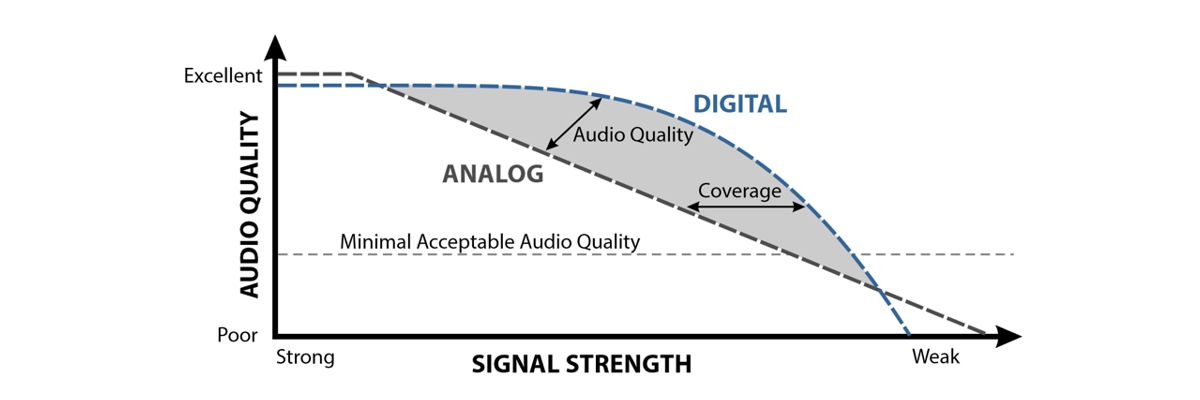
Digital processing actively filters out environmental background noise (like machinery, wind, or traffic), delivering pristine voice reproduction. Unlike analog signals that gradually dissolve into static as you move away from the transmitter, DMR audio remains crisp and perfectly intelligible right up to the very edge of the coverage perimeter.
DMR digital technology reduces noise and preserves voice quality over a greater range than analog radios, especially at the farthest edges of the transmission range. One of the reasons that DMR has an excellent range performance is the Forward Error Correction (FEC) and Cyclic Redundancy Check (CRC) coders specified in the DMR standard. These coders enable receiving radios to detect and correct transmission errors by analyzing bits inserted into messages that allow the receiving radio to tell if there is an error.
Benefit 3: Extended Coverage
In addition to improving audio quality to the edge of the coverage area, DMR increases the radio range and provides a significantly greater usable coverage area due to how it handles weak signals.
DMR utilizes built-in FEC algorithms to insert mathematical check bits into transmissions. The receiving radio uses these bits to automatically detect and correct data errors caused by signal degradation, reconstructing clear audio where an analog signal would just be static.
DMR enables better interference rejection with digital signal processing that inherently screens out RF noise, static, and ambient environmental sounds. This prevents the signal-to-noise ratio from decaying over long distances.
DMR supports connecting multiple repeater sites over IP Networks. The digital nature of DMR makes it easy to link multiple DMR Tier II repeaters together over standard internet connections. This allows organizations to seamlessly bridge separate sites and extend communication range across cities, states, or countries. IP Site Connect links multiple DMR Tier II repeater sites over an IP network. Each repeater site provides its own local coverage radius, and the IP network connects those coverage areas allowing users at one site to communicate with users at another site through programmed channels or talk groups. Extended Pseudo Trunking (XPT) can also connect multiple repeater sites over an IP network and adds the benefit of increased group calling capacity.
Benefit 4: Longer Battery Life
TDMA transmits information in short bursts, which conserves the radio’s battery power, resulting in longer battery life. For example, in a typical duty cycle of 5 percent transmit, 5 percent receive, and 90 percent idle, the transmit time accounts for a high proportion of the drain on the radio’s battery. By cutting the effective transmit time in half, two-slot TDMA can enable up to 40 percent improvement in talk time in comparison with analog radios, and up to 20 percent compared to NXDN radios. This feature is particularly useful in environments where a radio user may be away from a power source for an extended period, such as in remote areas or during extended shifts.
Benefit 5: Flexible Calling and Interconnect Options
The DMR standard defines a variety of call types that give users the communication flexibility to define specific types of radio calls that fit the circumstances of each specific application.
- Individual (or Private) one-to-one calls
- Group Calls from an individual to a group, or from one group to another
- All Call (Broadcast call) to everyone regardless of what Group they are in
- Emergency Calls (can be All Call or specific groups)
Group Calls and Zones
DMR radio systems utilize channels, groups, and zones to organize clear and effective communication between individuals or groups within a specific range.
Telephone and Gateway Calls
DMR also supports telephone and gateway calls. PSTN and PABX telephone systems can be connected to DMR radios using DMR repeaters. Gateway calls support connectivity with Push-to-Talk over Cellular (PoC) and analog radio systems. Radio over IP (RoIP) Gateways are inexpensive devices that connect LTE PoC radios, analog radios, and even non-DMR-compliant third-party radios to DMR radio systems.
Caller Identification
An important part of radio communications is knowing who is making a call. Whether it is an individual, a group or a dispatcher, DMR radios can display the Caller ID using the Talking Party Identification service in the DMR standard to display the identity of the radio terminal or dispatcher transmitting in an individual or group call in all other radio terminals receiving the call.
Benefit 5: Transmission of Digital Data
The end-to-end digital nature of DMR enables applications such as text messaging, GPS, and other digital applications to be easily added onto radio devices and systems.
GPS Location Tracking: A DMR radio can have a built-in GPS receiver that calculates a user’s location coordinates from satellites. The radio then packages this location data into small digital data packets and transmits it to a dispatch application.
Text Messaging: DMR radios support sending and receiving digital text messages to discretely share critical data or status updates.
Over-the-Air Programming (OTAP): This enables centralized management and remote upgrades without pulling radios from the field.
Benefit 6: Digital Integrations
Another benefit of the DMR standard is the ability to integrate digital radio communication with connected devices, control systems, and facility equipment. When DMR radios are configured with programmable input/output (I/O) capabilities, they can do more than carry voice calls. They can help authorized users trigger equipment, monitor status changes, and connect radio communication with operational workflows.
This is especially valuable for facilities, manufacturing plants, logistics yards, campuses, hospitality properties, utilities, and other organizations that need fast communication and remote control from the same radio platform.
Access Control Systems and Motorized Gates
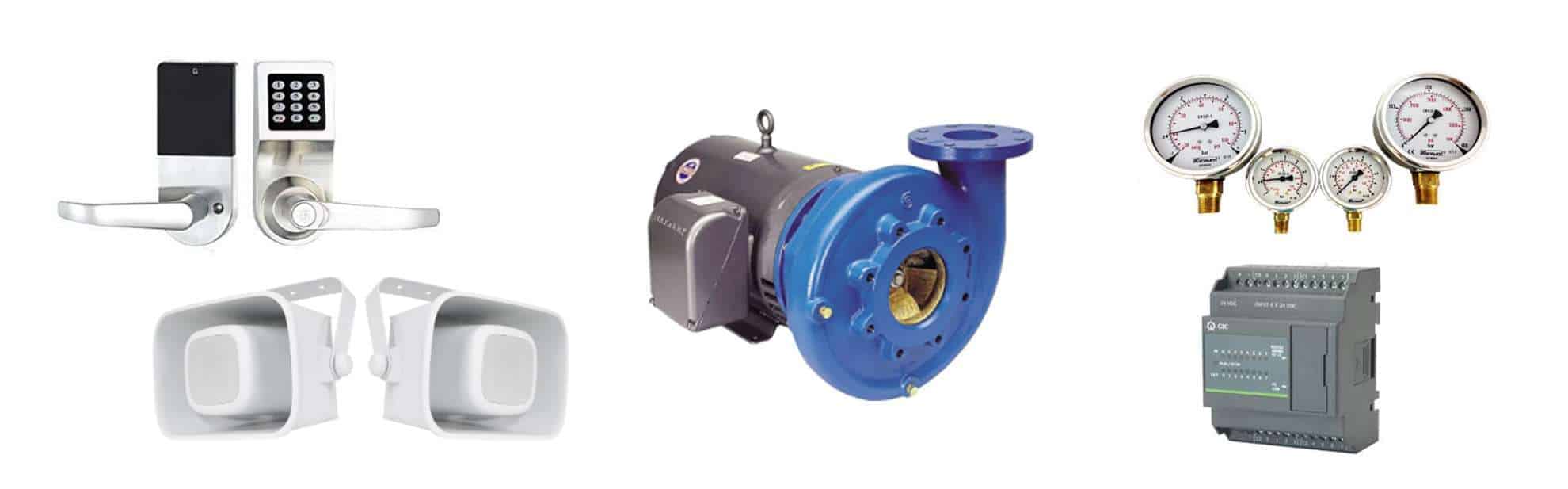
DMR radios can be integrated with doorway control systems so authorized radio users can activate electronic door locks, open controlled access points, or operate motorized gates. In this type of setup, a radio command or programmed group ID can be used to trigger a relay or control signal that unlocks a door, opens a gate, or grants access to a restricted area.
For example, a facilities team could use a DMR radio to open a service gate for a delivery vehicle, unlock a maintenance access point, or control an electronic entry point without needing to leave the work area. These integrations can also be designed to work alongside card readers, push-to-exit buttons, and other access control components.
Mass Notification Systems
DMR radios can also integrate with public address systems and facility alerting devices. This allows authorized radio users or dispatchers to trigger announcements, warning sirens, strobes, or other notification devices from the radio system.
In a school campus or large manufacturing plant, or other large facility, this connects two-way radio communication with broader facility-wide alerts. For example, a security or safety manager could use the radio system to activate a PA announcement for an evacuation procedure or emergency message.
This benefit is strongest when the organization needs to reach people who may not be carrying radios. A radio call reaches radio users, while a PA or strobe system can reach a wider area of the facility.
Manufacturing Equipment and Industrial Controls
DMR radios with programmable I/O can also interact with SCADA equipment, manufacturing equipment, and industrial control systems. By mapping radio commands to physical input/output lines, a DMR system can trigger relays, detect contact closures, or send control signals to connected equipment.
Potential integration examples include:
- Water and fuel pumps
- Ventilation fans
- Generators
- Conveyor belts
- Process automation controls
- Solenoid valves
- Programmable logic controllers
- Level and float switches
- Pressure and temperature gauges
- Smoke, intrusion, and tamper sensors
In practical terms, a radio command could be used to activate or shut down equipment, while monitoring inputs can report a status change back through the system. This can help operations teams reduce response time, coordinate equipment activity, and monitor critical facility conditions from the same communication environment used for voice calls.
Why This Matters
These integrations show how DMR can function as more than a voice communication system. For organizations with distributed teams and connected equipment, DMR can help bridge push-to-talk communication with facility control, monitoring, and operational response.
The key benefit is workflow efficiency. Instead of requiring a user to return to a control room, make a phone call, or access a separate system for every action, a properly designed DMR integration can allow authorized users to communicate, coordinate, and trigger approved devices through the radio system.
Benefit 7: Support for Worker Safety Features
DMR radios feature an array of automated, hardware-level protective safety features designed for hazardous industrial environments or lone-worker operations:
- Emergency Alarm Button: A dedicated, highly visible orange button that forces an instant priority alert across the network.
- Man Down: Internal gyroscopes trigger a rapid distress sequence if a radio stays tilted at an unapproved angle for too long, indicating a fall.
- Lone Worker: An automated, intervals-based check-in timer that sounds a system-wide alert if an isolated worker fails to interact with their radio.
- Priority Interrupt: Empowers dispatchers or supervisors to instantly clear active channels for critical emergency transmissions.
- Remote Monitor / Stun & Revive: Allows managers to audit audio in crisis situations or remotely deactivate lost or stolen hardware.

Benefit 8: Agility for Scalable System Growth
DMR radio systems can start small and expand as operational needs change. Some businesses may begin with radio-to-radio communication. Others may require a Tier II repeater system for larger facilities or campus coverage. Organizations with multiple buildings or properties may move into IP Site Connect. Teams that need more group calling capacity may want to evaluate XPT systems. Large, distributed organizations may require DMR Tier III trunking.
This scalability is one of the strongest reasons to treat DMR as a system strategy, not only as a radio purchase. A properly planned DMR system can support phased growth in users, locations, talk groups, dispatch tools, and network management.
Frequently Asked Questions
The main benefit is a more efficient, clearer, and more scalable digital radio communication system. DMR uses two-slot TDMA in a 12.5 kHz channel, allowing two communication paths where an analog channel typically supports one.
Yes. DMR improves audio quality by using digital voice processing to reduce background noise, static, and signal degradation. Unlike analog radio audio, which gradually becomes weaker and more distorted as users move toward the edge of coverage, DMR helps preserve clearer, more intelligible voice communication over more of the usable coverage area.
DMR improves usable radio coverage compared with analog radio because it handles weak signals more effectively. Forward Error Correction helps receiving radios detect and correct transmission errors, which allows clearer audio to remain usable in areas where analog audio may become noisy or difficult to understand. DMR systems can also extend coverage by connecting multiple repeater sites over IP networks.
Yes. DMR systems can support input/output functions to trigger relays, monitor status changes, activate equipment, or connect radio communications with facility systems. Examples may include access control gates, door locks, PA systems, warning devices, pumps, fans, generators, conveyor belts, sensors, gauges, and industrial controls.
TDMA divides a channel into two alternating time slots. This helps increase call capacity, improve spectrum efficiency, and reduce how long each radio transmits during normal use.
Depending on the radio, system, software, and programming, DMR systems may support text messaging, GPS location data, radio identification, emergency signaling, and dispatch-related data services.
Yes. DMR is an ETSI-developed digital radio standard promoted by the DMR Association. Standards-based design helps support interoperability and long-term system planning when products are compliant and properly configured.