
What Is IP Site Connect?

IP Site Connect is a DMR multi-site system that links multiple Tier II repeater sites through an IP network so radio users at different locations can communicate as part of a wider radio network. It is useful for businesses with multiple buildings, campuses, yards, or facilities that need connected coverage without moving directly to trunking.
IP Site Connect Overview
IP Site Connect, sometimes called IP Connect, is a DMR multi-site architecture that links multiple DMR Tier II repeater sites through an IP network. Instead of each repeater site operating as an isolated local system, IP Site Connect allows users at separate locations to communicate as part of a wider radio network.
IP Site Connect uses Internet Protocol to link DMR Tier II repeaters, allowing multiple repeater sites to connect over a standard IP network. This makes it useful for organizations with several buildings, campuses, warehouses, facilities, yards, or remote locations that need connected radio communication.
In short, IP Site Connect is primarily a coverage-expansion strategy. It connects DMR Tier II sites over IP so users in different places can communicate without requiring every team to be physically within one repeater coverage area.
How IP Site Connect Works
In an IP Site Connect system, each repeater site remains a DMR Tier II repeater site, but the repeaters are linked through an IP network. The connection can use third-party networks such as the internet, LAN/WAN, VPNs, carrier Ethernet, or microwave links, depending on system design and reliability requirements. Standard network routers are typically used to provide the IP connectivity
The DMR protocol is transported through TCP/IP at the application layer. In practical terms, the IP link changes how DMR information is transported between sites, but it does not require users to learn a fundamentally different radio workflow. Group calls, individual calls, and emergency call workflows can operate in familiar ways when properly configured.
Multi-Site Workflow
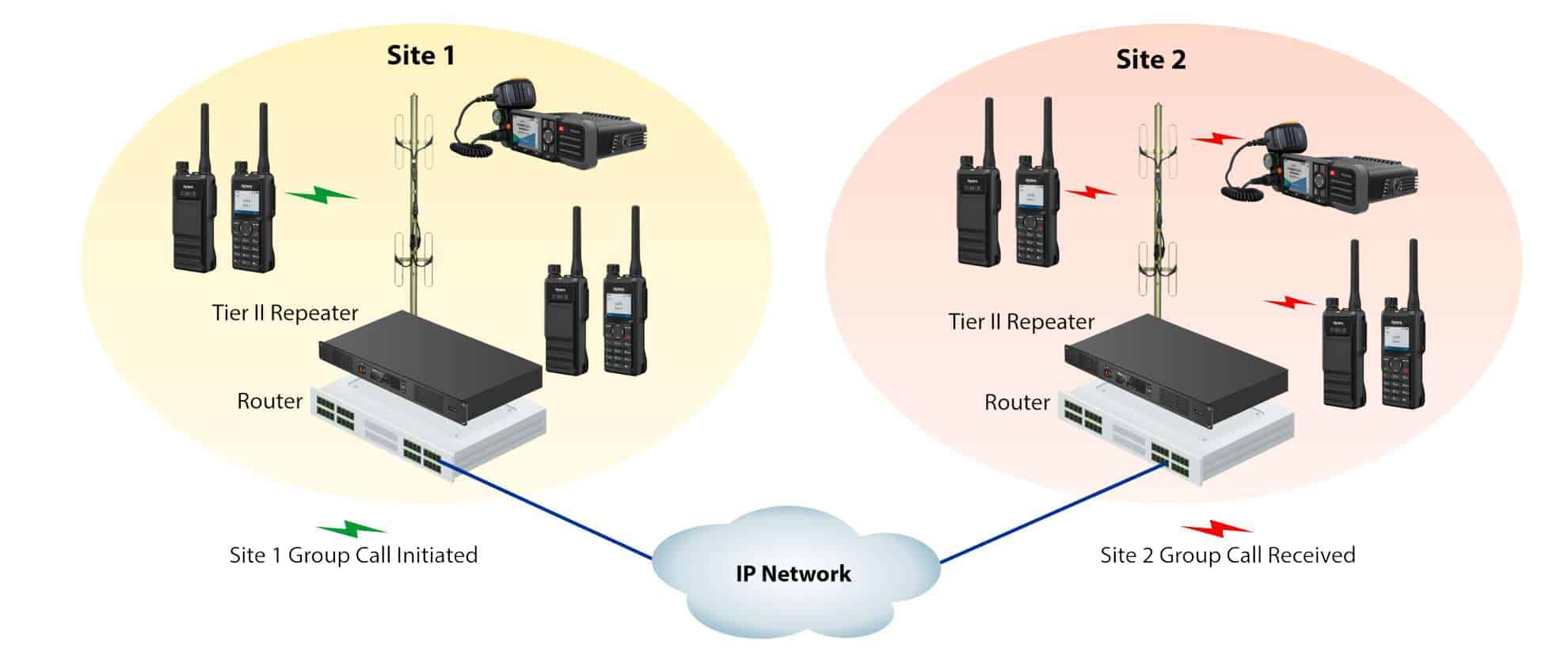
Consider a business with two facilities. Site 1 has a DMR repeater, and Site 2 has another DMR repeater. Each repeater is connected to an IP network through a router. A user at Site 1 selects a channel or talk group intended for Site 2. The Site 1 repeater receives the transmission and sends the radio traffic through the IP network. The Site 2 repeater receives the traffic and retransmits it to the appropriate users at Site 2.
From the user perspective, this can feel like communicating through a broader radio system rather than switching to a phone or separate communication platform. The value is not only wider geographic reach, but also consistent push-to-talk operation across distributed locations.
.
Business Use Cases for IP Site Connect
IP Site Connect is useful when an organization has more than one location and wants radio users to communicate across those locations. Common business use cases include:
- School districts with multiple campuses
- Universities with satellite facilities
- Manufacturing operations with separate production, warehouse, and administrative buildings
- Logistics companies with multiple yards or distribution points
- Hospitality properties with separate buildings or outdoor areas
- Utilities and facilities teams that move between remote operating areas
- Large campuses that need local communication plus wider coordination
The key planning question is whether the organization needs wider coverage across sites or more calling capacity at a single site. IP Site Connect helps with wider coverage. XPT and Tier III are usually the next conversations when capacity or advanced trunking becomes the primary issue.
Scalability, Roaming, and Network Design
IP Site Connect systems can link multiple repeaters and support up to 255 locations by configuring primary and secondary repeaters. Each location can use a different frequency, and the IP transport can use different media such as fiber, microwave, or other network paths depending on design.
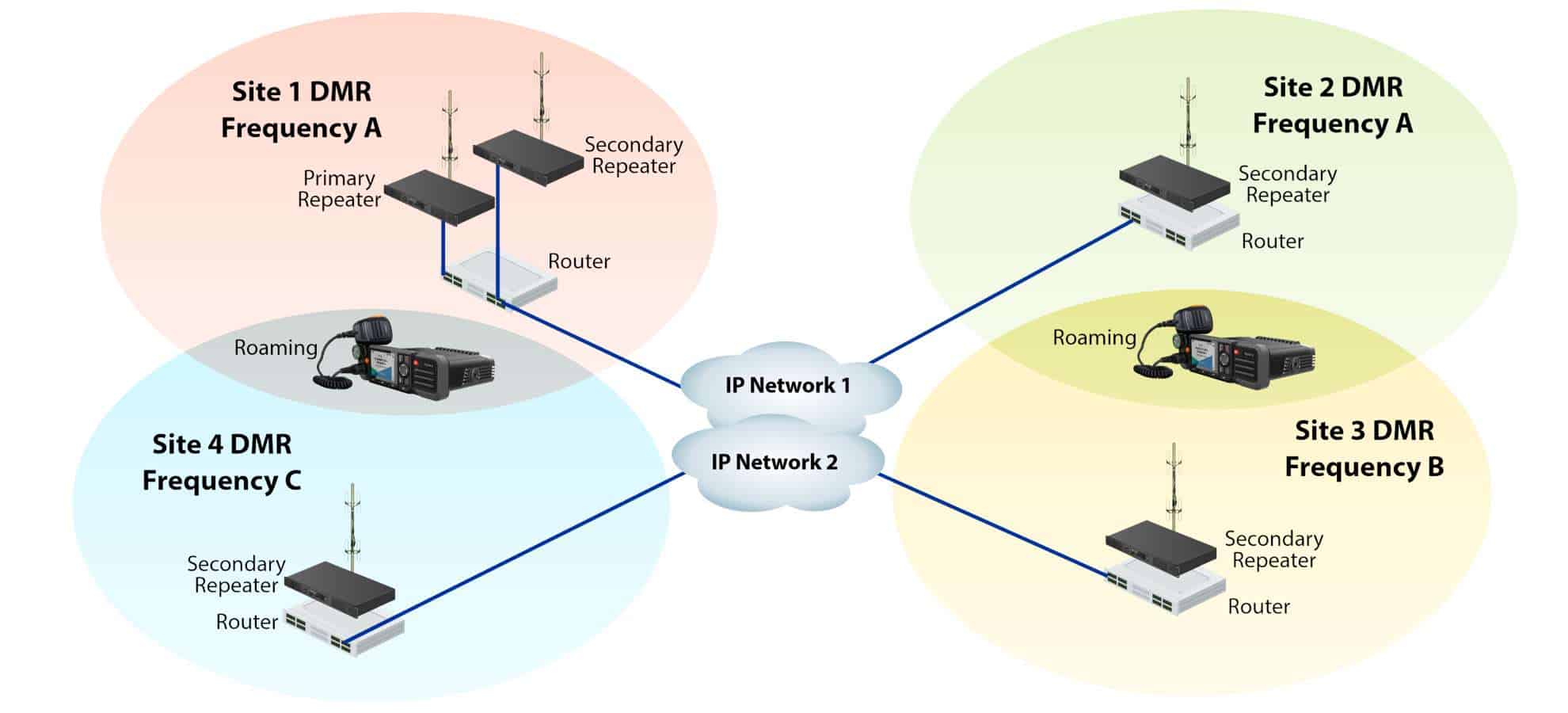
When coverage areas overlap, roaming can allow a radio to switch between sites automatically. This is especially useful for vehicles or mobile staff moving between repeater coverage areas. Roaming requires careful frequency planning, site design, and radio programming.
Benefits of IP Site Connect
Expanded Multi-Site Coverage
IP Site Connect helps organizations expand DMR radio coverage by linking multiple repeater sites over an IP network. This makes it useful for businesses, school districts, campuses, warehouses, industrial facilities, parking structures, and multi-building properties where a single repeater site may not provide complete coverage.
It can also help address difficult coverage areas such as large parking garages, below-ground floors, remote buildings, outdoor work areas, or separate facilities that need to communicate through the same radio system.
Simple System Expansion
IP Site Connect can connect repeater sites using commonly available IP networks, including the internet, private wide area networks, local area networks, and VPNs. This gives organizations flexibility when extending radio coverage across locations.
For organizations already using compatible Hytera repeaters, IP Site Connect may not require replacing existing repeater hardware. In many cases, the system can be expanded by adding the appropriate IP Site Connect license, configuring the repeaters, and connecting the sites through the required IP network. Actual requirements depend on repeater models, software, licenses, network design, and system configuration.
DMR Protocol Support
Hytera IP Site Connect carries DMR protocol across the connected repeater network. This allows properly programmed and compatible DMR radios to operate across the extended system while preserving familiar DMR calling features.
Because the system is based on DMR operation, organizations can often extend coverage without forcing users into a completely different radio workflow. Compatibility still depends on radio models, supported features, programming, encryption settings, talk group structure, and system configuration.
Familiar User Operation
IP Site Connect is designed to keep radio operation simple for users. Employees can continue using familiar DMR features such as group calls, individual calls, and emergency calls when those features are supported by the radios, repeaters, and programming.
This makes IP Site Connect a practical option for organizations that need wider coverage but do not want to add unnecessary complexity for everyday radio users.
Local and Wide-Area Talk Group Programming
A Hytera IP Site Connect system can be programmed so some talk groups stay local to a single repeater site while others operate across the connected multi-site network. This gives organizations more control over who hears which calls and helps reduce unnecessary radio traffic across the entire system.
For example, a school district may configure each campus with local repeater communication for day-to-day operations while also supporting district-wide talk groups for announcements, emergency communication, transportation coordination, or administrative calls that need to reach multiple campuses.
Because IP network performance affects real-time radio traffic, network planning matters. Delay, jitter, packet loss, bandwidth, firewall configuration, and network redundancy can all affect performance. IT staff should work with an authorized Hytera dealer or systems integrator to design and validate the network.
Limitations and When to Upgrade
IP Site Connect extends coverage, but it does not solve every capacity problem. It enables users at multiple repeater sites to communicate over wider areas, but call capacity remains limited by the available DMR time slots and system design. If an organization has many talk groups competing for access, trunking may be required to expand capacity.
When busy channels become the primary problem, XPT may be the next step for expanding group calling capacity. When the organization needs advanced trunking, centralized control, user management, priority handling, and broad network resiliency, DMR Tier III should be evaluated.
Frequently Asked Questions
IP Site Connect links multiple DMR Tier II repeater sites over an IP network so users at different sites can communicate across a wider radio network.
IP Site Connect extends coverage across locations, but it does not expand call capacity the way XPT or Tier III trunking can. It links Tier II repeater sites, but capacity remains tied to the available time slots and system design.
IP Site Connect can operate using third-party IP networks such as the internet, LAN, WAN, VPNs, or microwave links, depending on the design and performance requirements.
When coverage overlaps and the system is configured properly, roaming can allow a radio to switch between sites automatically as a user moves between coverage areas.
Consider IP Site Connect when multiple locations need radio communication with each other, but the organization does not yet need XPT capacity expansion or full DMR Tier III trunking.