
What Is a DMR Tier III Trunking System?

Large organizations implement Tier III trunked systems when their communications require:
- High-Capacity Call Handling: Dynamic voice and data routing for thousands of simultaneous users.
- Wide-Area Connectivity: Seamless multi-site network management spanning broad geographic territories.
- Advanced User Governance: Centralized radio registration, strict access control, and tiered call priorities.
- Network Resiliency: High-availability architecture featuring automated fault backup and system redundancy.
DMR Tier III Overview
DMR Tier III represents the elite, fully trunked classification of the global ETSI Digital Mobile Radio standard. Engineered specifically for mission-critical operations that outgrow conventional repeater models, a Tier III architecture eliminates static channel constraints by dynamically assigning available radio resources the precise second a user presses push-to-talk.
Rather than a basic hardware or standalone repeater upgrade, Tier III is an integrated IP-based digital trunking ecosystem designed to manage high-capacity voice call topologies, enterprise data transport, and automated system roaming across vast geographic footprints.
How DMR Tier III Trunking Works
The core mechanic of trunking is the automated maximization of shared resources. In conventional systems, talk groups are restricted to rigid, unyielding channel paths. Tier III treats all available frequencies as a fluid, shared pool. When a DMR two-way radio initiates a call, the system instantly draws an open traffic path from the pool; the absolute moment the transmission terminates, that channel is released back into the collective pool for other field teams to utilize.
The Architectural Core
Tier III routes traffic and monitors devices across centralized and localized nodes via an interconnected IP network:
- Mobile Switching Office (MSO): The master central processor of the network. The MSO governs global call routing, cross-system gateways, and complete network coordination.
- Base Station Controller Unit (BSCU): Located physically at individual repeater sites, the BSCU commands localized radio assets and executes real-time channel handoffs.
- Trunked Repeaters: Dedicated base stations engineered to carry voice packets, messaging strings, and system data over dynamically assigned slots.
- Wide Area Network (WAN): The high-speed IP backhaul that connects the centralized MSO, site BSCUs, trunked repeaters, and desktop dispatch applications.
Tier III integrates advanced application tools like the Multimedia Recording and Playback System (MRPS). The MRPS acts as a secure communications vault, logging and archiving all over-the-air voice transmissions alongside comprehensive system metadata. This provides large enterprises with a definitive audit trail to support field accountability, optimize training routines, and maintain absolute regulatory compliance.
Control Channels and Traffic Channels
The foundational engineering element that separates a DMR Tier III architecture from simpler conventional networks is the implementation of a dedicated control channel.
The Functional Split:
- The Control Channel: Requires a dedicated FCC FB8 frequency that remains constantly active. Radios do not carry voice calls on this path; instead, devices use it exclusively to register with the network, broadcast GPS location updates, and request communication paths.
- The Traffic Channels: The remaining frequencies inside the shared pool, used exclusively to carry active digital voice calls, data payloads, and text strings.
This automated architecture enables large organizations to manage thousands of user terminals across a minimal number of spectrum licenses, ensuring maximum data efficiency and eliminating manual channel checking.
Tier III System Layers
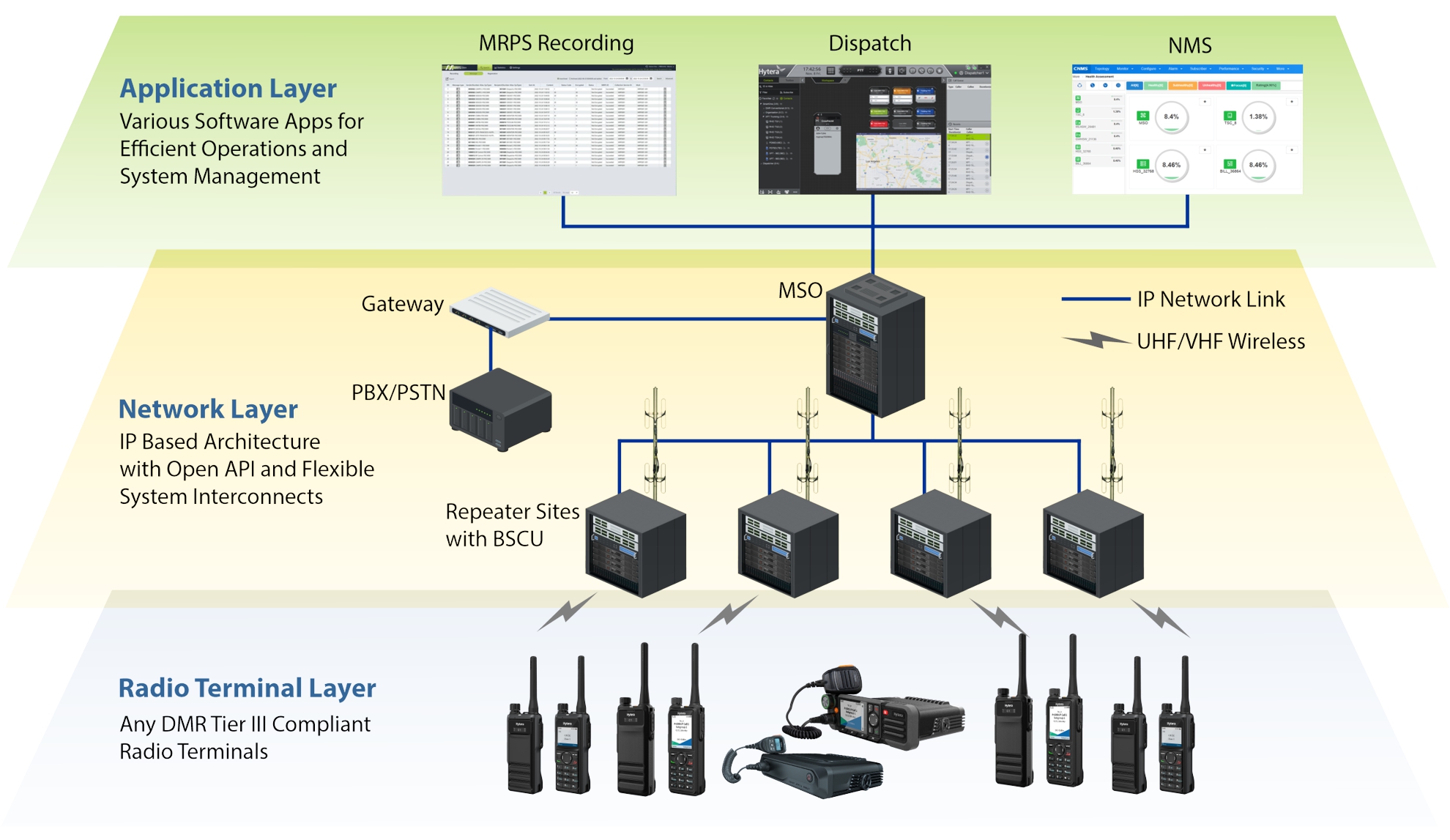
Because a Tier III network is designed to manage overarching access permissions, resource allocation, and device behavior rather than simply extending localized range, its architecture is categorized into three distinct layers:
| System Layer | Core Technical Focus | Hardware & Software Assets Included |
|---|---|---|
| Application Layer | Operational Oversight & User Interface | Desktop dispatch consoles, real-time GPS fleet tracking suites, network monitoring utilities, and MRPS logging vaults. |
| Network Layer | Central Control & Traffic Management | Centralized MSOs, localized site BSCUs, trunked repeaters, IP switches, backhaul routers, and system network gateways. |
| Radio Terminal Layer | Field Communications & Endpoints | Commercial-grade handheld portable radios, mobile vehicle-mounted radios, and specialized heavy-duty desktop base stations. |
Specialized Mobile Radio (SMR) Networks
For enterprises requiring wide-area geographic coverage but wanting to avoid the capital hurdles of deploying private infrastructure, Specialized Mobile Radio (SMR) networks provide a compelling alternative. SMR networks are commercial, large-scale radio systems managed by third-party operators (such as systems integrators, established dealers, or network providers) who invest in the foundational FCC licensing, site acquisition, backhaul, and system upkeep. Instead of buying the physical infrastructure, businesses simply lease radios, airtime, and secure system access.

Because DMR Tier III is built natively for wide-area scaling and dynamic traffic allocation, it serves as the premier technology standard for modern SMR operators.
Core Operational Advantages of SMR:
- Minimized Capital Expense (CapEx): Eliminates the massive upfront infrastructure costs of purchasing private MSOs, controllers, and multi-site repeaters.
- Vast Geographic Reach: Grants field teams immediate access to expansive county, regional, or metro-wide coverage zones handled by the provider's network layout.
- Turnkey System Governance: Outsources ongoing system diagnostics, hardware upgrades, tower maintenance, and regulatory frequency management to a specialized operator.
- Advanced Fleet Control: Subscribers still retain advanced Tier III privileges, including discrete talk groups, centralized dispatch options, GPS location mapping, call recording, and priority queuing.
Assessing the Strategic Fit
- When to Choose SMR: Highly recommended for transportation fleets, regional utility contractors, distributed logistics networks, and expansive operations spanning wide geographic perimeters where establishing a private network is cost-prohibitive.
- When to Stay Private: Organizations managing a single dedicated facility, localized school district, or single industrial campus are usually better served by deploying an on-premise private Tier II repeater network, IP Site Connect, or a Hytera XPT system.
Key Benefits of Tier III for Enterprise Operations
Maximum Efficiency and Capacity – DMR Tier III trunking systems increase channel usage efficiencies by dynamically managing their allocation for high traffic calling applications. DMR provides two communication pathways in one 12.5KHz channel. So, combining the efficiencies of trunking technology with the advantages of DMR results in a highly efficient wide area solution. DMR Tier III is designed for applications with high individual calling traffic with many users making radio-to-radio calls, and it always knows where the radio is and can find the most efficient (singular talk path) instead of using all the talk paths on the whole system. All devices are based on IP architecture to ensure flexible networking and system expansion.
Dedicated Management Channel – DMR Tier III trunking increases efficiency of channel usage with large groups of radios users using a dedicated control channel, managed by a server. This allows for maximizing channel frequency resources for high-volume call traffic and multiple user talk groups.
Leverages the Full Features of DMR – DMR Tier III systems also support all the features of conventional systems as defined in the DMR industry standard. Calling Features: Group call, all call/broadcast, individual calling, priority calling. Digital Features: integrated GPS, secure encryption, and text messaging (free form and preconfigured). Safety features: emergency calling, man down, lone worker, priority interrupt, remote monitor, and stun and revive.
Versatile Services – In addition to the standard DMR voice and data services, Tier III supports priority, late entry, call back, recording, Public Switched Telephone Network (PSTN) calling. DMR Tier III also supports advanced services like call preemption and call queuing, dynamic site light up, and dynamic group allocation, late entry into a group call, ambience listening, interrupt/override, dynamic group number assignment, voice recording, and group patching.
User Management and Calling Priority – Large organizations organize users into many levels of access required for different types of communication. DMR Tier III Systems offer a multitude of different management services to allow radios to interact with the network. Radios are registered on the network for identification and can be configured with subscriber area restrictions and control channel reselection. DMR Tier III systems also support different call priority levels to ensure calls from supervisors, security, and emergency response, get priority through the system for guaranteed communications in critical situations during heavy call traffic.
System Interoperability – Like DMR Tier II systems, DMR Tier III systems support interconnection gateways to PSTN/SIP/PBX/VoIP phone systems, analog conventional systems, MPT, DMR conventional, etc. DMR Tier III also features an open Application Programming Interface (API) that enables further development based on different customer needs, such as billing systems, e-mail gateways, etc.
Radio Registration Service – Radios register with Tier III systems for access control. This gives the network operator control over who can connect and talk on the system and provides users with registered access levels that enable granular control of call groups, call types, and calling priority.
Enhanced Security – Like most DMR radio systems, Tier III supports standard and advanced (256 bit with AES and ARC4 algorithm) encryption for radio communications, but Tier III adds Electronic Serial Number authentication (ESN Check) that provides security control over system access by confirming the serial number of an individual radio before granting communications access.
Mission Critical Resiliency and Redundancy – DMR Trunking combines optimal radio coverage with intelligent redundancy design, so the availability of the overall system is ensured even on the failure of individual components. DMR Tier III systems have several redundancy mechanisms available to ensure guaranteed operation and service availability. With the MSO at the heart of the system, it supports local and geographical backup and triple failover redundancy to ensure continuous wide-area operation. Other controller hardware can also be used in redundant configurations with several failsafe modes. All these configurations are scalable and can be adjusted at any time during the lifecycle of the system. So, systems can start small, and redundancy can be added as the system grows.
Over The Air Programming – DMR Tier III supports reliable and robust Over the Air Programming (OTAP) that enables centralized control of each radio on the system and provides a very convenient method to automatically upgrade and reconfigure radios in the field. OTAP saves many hours compared to the standard benchtop configuration of radios that requires plugging each radio into a computer and manually programming them.
Powerful Software Applications – Tier III systems include network management software, as well as the dispatcher and voice recorder systems ensure DMR Trunking is a comprehensive and professional solution, providing central management of the radio system and supporting remote maintenance.
When Tier III Makes Sense
DMR Tier III is not a generalized solution for every environment; it is an industrial infrastructure investment built explicitly for high-density traffic and complex fleet management.
Enterprise Deployment Indicators
Your organization should evaluate a Tier III trunking architecture if you meet these operational criteria:
- High Volume Density: Your radio network handles intense, simultaneous voice and data call spikes across thousands of registered radios.
- Wide-Area Footprint: Field teams operate across vast geographic regions, requiring fluid multi-site handoffs and seamless over-the-air roaming.
- Granular User Administration: Security teams require centralized control over individual device privileges, channel access mapping, and comprehensive audit logs.
- Mission-Critical Reliance: The operational workflow requires absolute network uptime, necessitating built-in hardware redundancy and automatic fallback paths.
Organizations with single-property facilities or localized campuses are highly encouraged to evaluate conventional Tier II repeaters, IP Site Connect multi-site networks, or capacity-boosting Hytera XPT systems before engineering a full Tier III system layout.
What to Confirm Before Choosing Tier III
A Tier III decision should be made with an authorized Hytera dealer or systems integrator. Before choosing, think about:
- Current and future user count
- Peak call volume and talk group behavior
- Individual calling demand
- Required geographic coverage
- Available licensed spectrum and control channel requirements
- Required dispatch, GPS, recording, and network management tools
- Redundancy, fallback, and uptime requirements
- Radio compatibility and migration from Tier II or analog
- Integration needs with other systems such as dispatch, telephone, or recording platforms
Because Tier III is more capable and more complex, upfront planning is critical. The goal is not to buy the largest system. The goal is to choose the system architecture that matches operational requirements and can grow without creating unnecessary complexity.
Frequently Asked Questions
Yes. DMR Tier III is the trunked version of the ETSI DMR standard. Instead of permanently assigning talk groups to specific frequencies, the system automatically assigns available traffic channels whenever a user transmits.
Tier III is the highest tier of the DMR standard for licensed land mobile radio systems. It adds centralized network control, dynamic channel allocation, roaming, registration, and advanced system management.
Yes. Tier III is defined by the European Telecommunications Standards Institute (ETSI) as the trunked implementation of the Digital Mobile Radio (DMR) standard.
The exact number depends on the system design, but Tier III systems are designed to support hundreds or thousands of subscriber radios across multiple sites while efficiently managing channel resources.
Yes. Because channels are dynamically assigned only when needed, Tier III makes much better use of available spectrum than conventional radio systems.
In many cases, yes. Existing DMR infrastructure may be reusable depending on the repeater models, network design, licensing, and system requirements. An authorized Hytera dealer can determine the best migration strategy.
Many DMR radios support Tier III operation, but compatibility depends on the radio model, firmware, and supported features. Older radios may require updates or replacement.
Not by itself. Coverage depends on repeater locations, antenna systems, terrain, and system design. Tier III improves network management and capacity rather than RF propagation.
Requirements vary by system size. At least one dedicated FCC licensed FB8 control channel is required, with additional licensed frequencies serving as traffic channels.
Yes. Tier III systems can integrate with SIP, PBX, VoIP, and PSTN telephone systems through appropriate gateways.
Costs vary widely depending on the number of sites, repeaters, frequencies, dispatch positions, redundancy requirements, and subscriber radios. An authorized dealer typically performs a system assessment before providing a proposal.
Tier III is generally the better choice when organizations require centralized management, individual call routing, roaming across multiple sites, advanced access control, redundancy, and support for very large fleets. XPT is often a more cost-effective solution for organizations that need increased capacity without the complexity of a full trunked system.