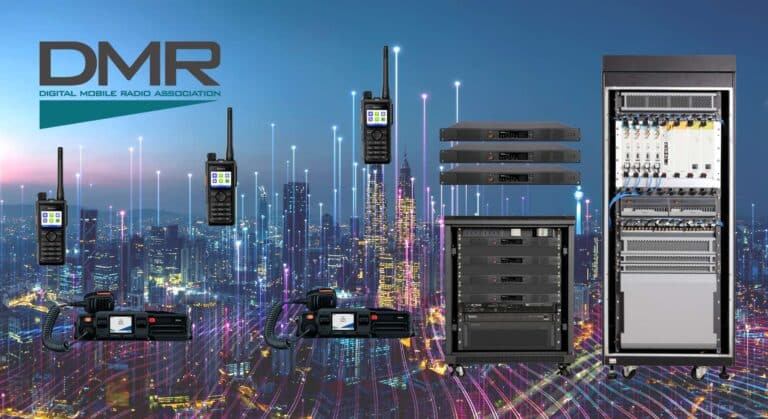

The Three Tiers of the DMR Radio Standard

The DMR standard is an ETSI-developed digital radio standard for professional mobile radio communication. It is organized into three tiers: Tier I for low-power license-free direct communication, Tier II for licensed conventional radio systems, and Tier III for licensed trunked radio networks that dynamically manage channels for larger organizations.
DMR Standard Overview
Digital Mobile Radio, or DMR, is an open digital radio standard developed by ETSI, the European Telecommunications Standards Institute, for professional mobile radio communication. DMR gives organizations a standards-based path from analog voice systems to digital radio systems with improved spectrum efficiency, clearer audio, support for voice and data services, and more flexible system design.
Rather than being a single product, DMR is a technical standard used by manufacturers to build radios, repeaters, infrastructure, and applications. The DMR Association also promotes the standard and provides standards resources for Tier I, Tier II, and Tier III systems.
DMR is commonly explained in three tiers. Each tier describes a different class of radio operation, licensing, infrastructure, and system complexity:
| DMR Classification | Spectrum Licensing | System Architecture | Primary Operational Focus |
|---|---|---|---|
| DMR Tier I | License-Free / Unlicensed | Direct Mode Only (No Infrastructure) | Low-power, short range |
| DMR Tier II | Licensed Spectrum Required | Conventional Mode (Direct or Repeaters) | Mainstream business networks, campuses, and multi-site facilities |
| DMR Tier III | Licensed Spectrum Required | Trunked Mode (Centralized Controllers) | Large enterprise fleets, public utilities, and wide-area networks |
Why DMR Was Organized Into Tiers
The tier-based structure ensures organizations do not overbuy advanced infrastructure they do not need or underbuy a platform that cannot scale. A small dispatch team operating in a single warehouse does not require the centralized system architecture of a multi-campus university, regional utility grid, or massive manufacturing facility.
The DMR tier framework maps to a clear, step-by-step technological progression:
- Direct Mode: Establish basic radio-to-radio communications for local teams.
- Licensed Channels: Secure licensed conventional frequencies to eliminate interference and gain professional range.
- Repeater Integration: Add conventional repeaters to overcome physical obstructions and expand localized site coverage.
- Multi-Site Connectivity: Connect separate physical locations across an IP or Ethernet backbone.
- Trunked Efficiency: Implement dynamic trunking architecture when high call volumes and large user counts strain available channels.
DMR Tier I: License-Free Direct Radio-to-Radio Communication
DMR Tier I represents the entry-level tier of the global Digital Mobile Radio standard. It is explicitly designed for short-range, low-power, direct radio-to-radio communications without the use of repeaters, controllers, or network infrastructure.
Tier I radios typically operate at up to 0.5 watts and are best suited for simple, small-scale communication needs such as recreational use, hobbyist activity, outdoor coordination, small events, and local communication where wide-area coverage is not required. Because Tier I is focused on direct-mode communication, users speak radio-to-radio rather than through a repeater site or networked system.
The key benefit of Tier I is simplicity. Users can communicate directly without radio system infrastructure, site equipment, repeaters, routers, or trunking controllers. However, that simplicity comes with limits. Tier I does not provide the same coverage, capacity, system control, scalability, or advanced feature set associated with licensed DMR Tier II or Tier III systems.
For business planning, Tier I is best understood as the simplest DMR tier. It may be useful for small, local, low-power communication needs, but organizations that require licensed frequencies, repeaters, dispatch integration, GPS, higher capacity, or larger coverage areas should evaluate DMR Tier II or Tier III instead.
DMR Tier II: Licensed Conventional Business Communication
DMR Tier II is the foundational standard for professional and commercial two-way radio networks. Operating on licensed spectrum, Tier II delivers the range, spectral efficiency, and system oversight that commercial enterprises require.
DMR Tier II Conventional Repeater Systems utilize two-slot TDMA technology, which divides one 12.5 kHz channel into two time slots so two separate voice or data paths can operate on the same licensed channel. This improves spectral efficiency and helps organizations support more radio traffic without requiring additional channels.
Depending on your hardware deployment and programming, Tier II networks support:
- Dedicated Group Calling and Individual Private Calls.
- Real-time GPS location tracking and data transmission.
- Integrated text messaging and emergency priority calling.
- Centralized dispatch panels and IP multi-site routing.
Expanding Range with Conventional Repeaters
For organizations whose coverage areas are limited by distance, rugged terrain, thick walls, or building obstructions, Tier II introduces conventional repeaters. A repeater works by receiving a radio signal and instantly retransmitting it at a higher power level. This expands reliable push-to-talk coverage across large production plants, multi-building education campuses, distribution warehouses, and expansive outdoor yards.
Extending Tier II Range and Expanding Call Capacity
When a commercial enterprise scales past a single site, DMR Tier II utilizes IP Site Connect to bridge separate physical environments over standard Ethernet or IP networks. This connects distant localized systems into a unified communication network.
This architecture is highly effective for geographically distributed operations, including:
- Separate school campuses or multi-building districts.
- Manufacturing facilities linked to remote logistics yards or offices.
- Large resort, hospitality, or entertainment properties with multiple zones.
- Distributed transportation, fleet management, or maintenance operations.
IP Site Connect solves geographical range limitations by stitching repeaters together. However, it does not automatically add dynamic channel allocation. If your primary bottleneck is radio traffic and channel congestion rather than physical distance, solutions like Extended Pseudo Trunking (XPT) or a full Tier III trunked system are more effective options.
DMR Tier III: Licensed Trunked Radio Systems
DMR Tier III represents the highest tier of the global standard, designed for enterprise-grade deployments, massive user groups, and mission-critical wide-area networks.
The Power of Dynamic Trunking
Unlike conventional systems where talk groups are locked to static channels, Tier III utilizes centralized trunking technology. When a user presses push-to-talk, an automated system controller instantly evaluates the entire network and dynamically allocates an open channel pool resource. Once the call ends, that channel is immediately freed for other users. This maximizes spectrum efficiency and eliminates channel congestion during peak traffic.
Enterprise Capabilities Include:
- Automated dynamic channel allocation and seamless cross-site roaming.
- High-capacity individual, group, and priority emergency calling.
- Full system redundancy, path resiliency, and network monitoring tools.
- Centralized radio registration, authentication, and access control.
Ideal Deployment Environments
Tier III trunking solutions are built specifically for large-scale operations with complex workflows, such as regional public utilities, multi-city transportation systems, extensive industrial complexes, and wide-area education networks. It provides the centralized control, security, and optimization that conventional architectures cannot deliver.
Standards, Interoperability, and DMR Planning
Implementing an open standard means your technology follows strict ETSI definitions governing air interface protocols, data management, and trunking standards. This approach helps minimize risk, improves equipment sourcing options, and simplifies the transition from legacy analog systems.
DMR is an open standard with many benefits. It is designed for cross-vendor compatibility, true cross-manufacturer interoperability depends on specific feature selections, firmware architectures, software licensing, and programming approaches. Advanced proprietary features, specialized digital encryption variants, and specific accessories may not translate across different brands. Always verify feature-level compatibility with your systems engineer before mixing hardware brands.
What to Confirm Before Choosing a DMR Tier
Before choosing a DMR tier or system architecture, organizations should verify the following:
- Whether the system requires FCC licensing in the operating band
- How many users need active radio communication during peak times
- How many talk groups need simultaneous communication
- Whether coverage is limited to one site or spread across multiple sites
- Whether the organization needs dispatch, GPS, recording, or monitoring
- Whether radio-to-radio communication is enough or repeaters are required
- Whether a conventional, IP-connected, pseudo-trunked, or Tier III trunked design is the right fit
- Which radios, repeaters, accessories, and applications are verified for the selected system
Choosing the right DMR tier should be based on operational requirements, not just radio count or system size. By confirming licensing, coverage, capacity, talk group structure, feature requirements, and verified equipment compatibility upfront, organizations can select a DMR architecture that supports current communication needs while leaving room for future growth, additional sites, and more advanced system capabilities.
Frequently Asked Questions
The three DMR tiers are Tier I, Tier II, and Tier III. Tier I is license-free, low-power direct radio-to-radio communication. Tier II is licensed conventional radio communication. Tier III is licensed trunked DMR for larger systems with dynamic channel management.
Tier II is commonly used for business and commercial radio systems because it supports licensed operation, repeaters, two-slot TDMA, professional voice services, and data features when supported by the system.
Yes. DMR Tier I is designed for low-power, license-free direct radio-to-radio communication where permitted by local regulations. It does not use repeaters or trunking infrastructure.
DMR Tier II operates in licensed spectrum and is designed for professional and commercial users. It can support conventional repeater systems, wider coverage, two-slot TDMA, group calling, text messaging, GPS, and dispatch-related features depending on system configuration.
DMR Tier III uses trunking to dynamically assign channels and resources across a larger system. It is designed for organizations that need high-capacity individual and group calling, wide-area coverage, dispatching, roaming, and radio management.
Yes. DMR is an ETSI-developed open digital radio standard. Open standards can support interoperability and long-term system planning when equipment is compliant and configured correctly.