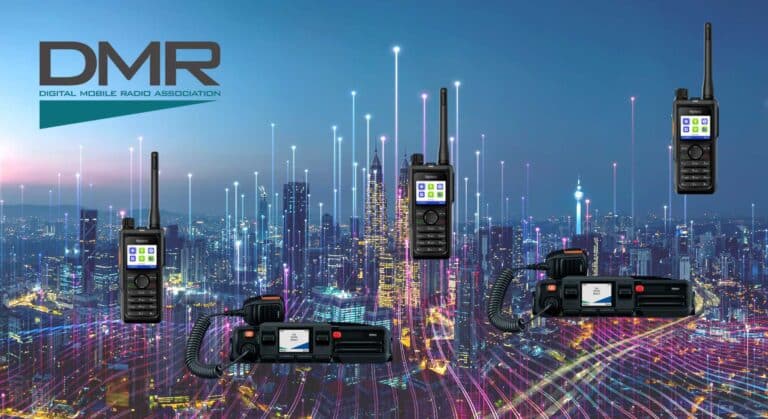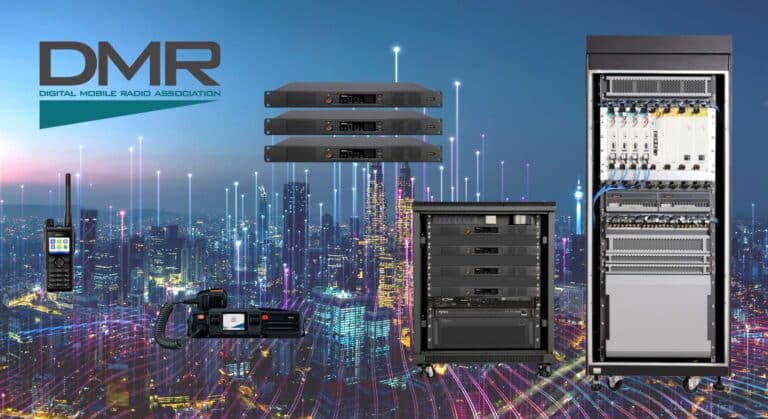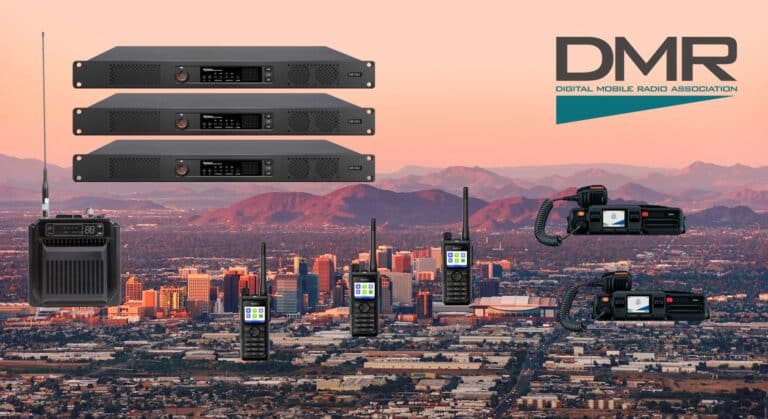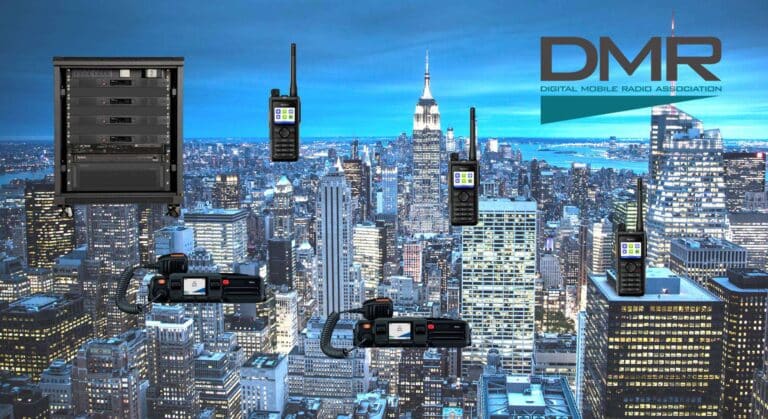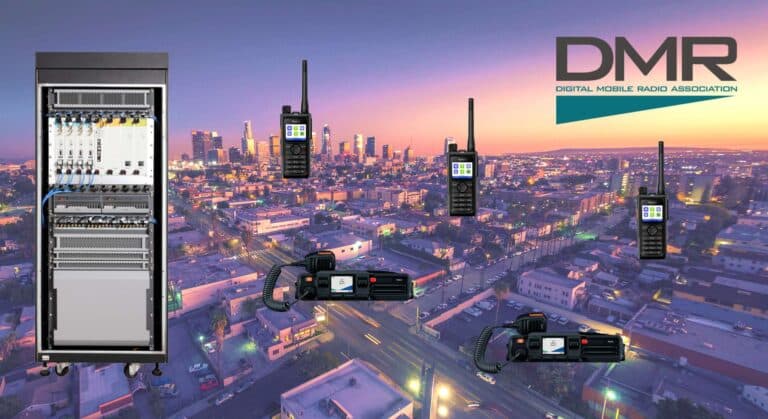

DMR Two-Way Radio Explained

DMR radio technology helps businesses improve two-way radio communication with clearer digital audio, efficient use of licensed spectrum, two-slot TDMA capacity, data services, and a standards-based migration path from analog radio systems. It is especially useful for organizations that need reliable push-to-talk communication across teams, facilities, campuses, vehicles, and large worksites.
What Is DMR?
Digital Mobile Radio (DMR) is the open radio industry standard developed by the European Telecommunications Standards Institute (ETSI) and promoted worldwide by the DMR Association. DMR is used for professional mobile radio communication, and is designed for business and organizational users who need reliable push-to-talk voice communication, group calling, data services, and scalable radio system architecture. DMR offers numerous advantages over analog radio systems, such as improved voice clarity, better range, longer battery life, and increased calling capacity.
Hytera was instrumental in the development of the DMR standard and was the first company to deploy a fully compliant DMR Tier III radio system.
In practical terms, DMR is the digital evolution of professional two-way radio. It allows organizations to move beyond basic analog voice communication and adopt a system that can support clearer audio, better channel efficiency, caller identification, text messaging, GPS data, dispatching applications, and more advanced system control when supported by the selected radios, repeaters, software, and configuration.
DMR systems are commonly used in commercial and enterprise environments such as manufacturing, warehousing, logistics, transportation, hospitality, education, facilities management, construction, energy, retail operations, and private security teams. The best system design depends on the number of users, the size and layout of the site, the number of locations, the amount of call traffic, the required features, and the available licensed frequencies.
A DMR system can be simple or complex. A small team may use DMR radios directly from radio to radio. A larger facility may need a DMR Tier II repeater system. A business with multiple locations may need IP Connect. A high-traffic site may need Hytera XPT. A large enterprise or network operator may require DMR Tier III trunking.
That ability to start with a simpler deployment and scale into more advanced infrastructure is one of the core reasons DMR is a strong fit for professional radio communication planning.
The Three DMR Tiers
To match different operational scales, the DMR standard is categorized into three distinct tiers:
DMR Tier I: Unlicensed & Low-Power
Designed for basic, direct radio-to-radio communication using low-power, consumer-grade equipment in open frequency bands. Note: U.S. business users must verify FCC licensing criteria prior to deployment.
DMR Tier II: Conventional Licensed Radio
The standard for professional business radio networks. Tier II supports direct radio-to-radio setups and conventional repeater systems across localized facilities or campuses. It serves as the foundation for multi-site IP networking and capacity-boosting solutions like Hytera XPT (Extended Pseudo Trunking). Operating a DMR Tier II repeater requires an FCC license. Tier II systems operate on licensed VHF or UHF bands and utilize higher power, requiring official spectrum authorization to prevent interference.
DMR Tier III: Trunked Multi-Site Networks
Built for large, mission-critical operations. Tier III utilizes centralized controllers to dynamically assign channels among hundreds of users and talk groups, providing automated routing, high efficiency, and wide-area coverage.
In short, DMR helps business radio users improve voice clarity, spectrum efficiency, group coordination, radio identification, and upgrade flexibility while preserving the familiar push-to-talk workflow employees already know. A business can start with a simple DMR deployment and scale into repeaters, IP-connected sites, XPT, or Tier III trunking as user count, call traffic, and operational complexity increase.
DMR Tiers at a Glance
| DMR Tier | System Type | Best For | Key Scalability Path |
|---|---|---|---|
| Tier I | Unlicensed/Direct | Personal/Low-power consumer use | None |
| Tier II | Licensed Conventional | Mid-sized facilities, campuses, & yards | IP Site Connect, Hytera XPT |
| Tier III | Licensed Trunked | Large enterprises, utilities, & wide-area fleets | Advanced Dynamic Routing |
How DMR Uses TDMA and 12.5 kHz Channel Spacing
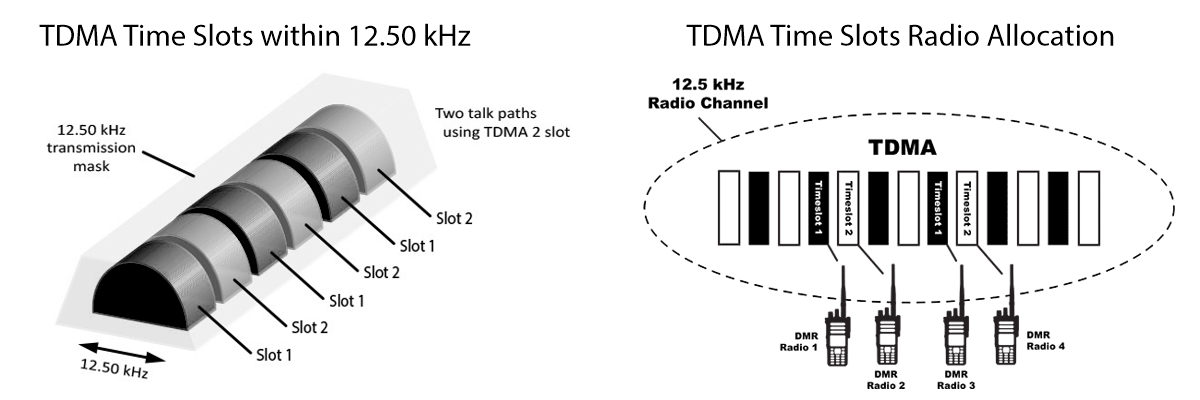
DMR uses Time Division Multiple Access, commonly called TDMA. In accessible terms, TDMA lets two separate communication paths share one 12.5 kHz radio channel by dividing the channel into alternating time slots.
Think of it like two conversations taking turns very quickly on the same channel. One conversation uses one time slot, and the second conversation uses the other time slot. To radio users, the process feels like normal push-to-talk communication, but the system is using the available spectrum more efficiently.
This matters because radio spectrum is limited. DMR’s two-slot TDMA design helps organizations get more communication capacity from existing licensed radio channels, depending on system design and configuration. It also supports digital services that are difficult or impractical to manage in a basic analog system.
What Are the Benefits of DMR Radio Technology?
DMR radio systems provide several advantages over legacy analog radio systems. The specific benefits depend on the radio models, system architecture, licensing, software, accessories, and configuration, but the major DMR advantages are consistent across professional deployments.
TDMA technology and 12.5 MHz channel spacing are two important technologies utilized in DMR two-way radios. These technologies provide a several benefits that improve the performance, reliability, and efficiency of DMR radios, and have resulted in the widespread adoption of DMR radios.
DMR, or Digital Mobile Radio, gives organizations a clearer, more efficient, and more scalable alternative to analog two-way radio systems. It improves voice quality, increases channel capacity, supports digital data, and gives businesses a practical path to expand their radio system as their communication needs grow.
More Calling Capacity
TDMA splits one 12.5 kHz channel into two alternating time slots. This allows two separate voice or data paths on the same licensed channel, effectively doubling calling capacity without requiring additional spectrum. Facilities, security, operations, logistics, and maintenance teams can communicate more efficiently without crowding the same channel.
Clearer Audio and Better Usable Coverage
Digital voice processing helps DMR radios reduce background noise, static, and interference from machinery, wind, traffic, and other noisy environments. Unlike analog radios, which gradually become harder to understand as the signal weakens, DMR audio can remain clearer closer to the edge of the coverage area.
DMR also uses Forward Error Correction to help receiving radios detect and correct transmission errors. This can improve intelligibility in weaker signal areas where analog audio may become noisy or unusable. For larger properties or multi-site operations, DMR repeaters can also be connected over IP networks to extend communication across buildings, campuses, cities, or regions.
Longer Battery Life
DMR radios transmit in short bursts instead of transmitting continuously during a call. Because the radio spends less time actively transmitting, TDMA can help reduce battery drain and extend talk time. This is valuable for employees working long shifts, covering large properties, or operating away from a charger for extended periods.
Flexible Calling Options
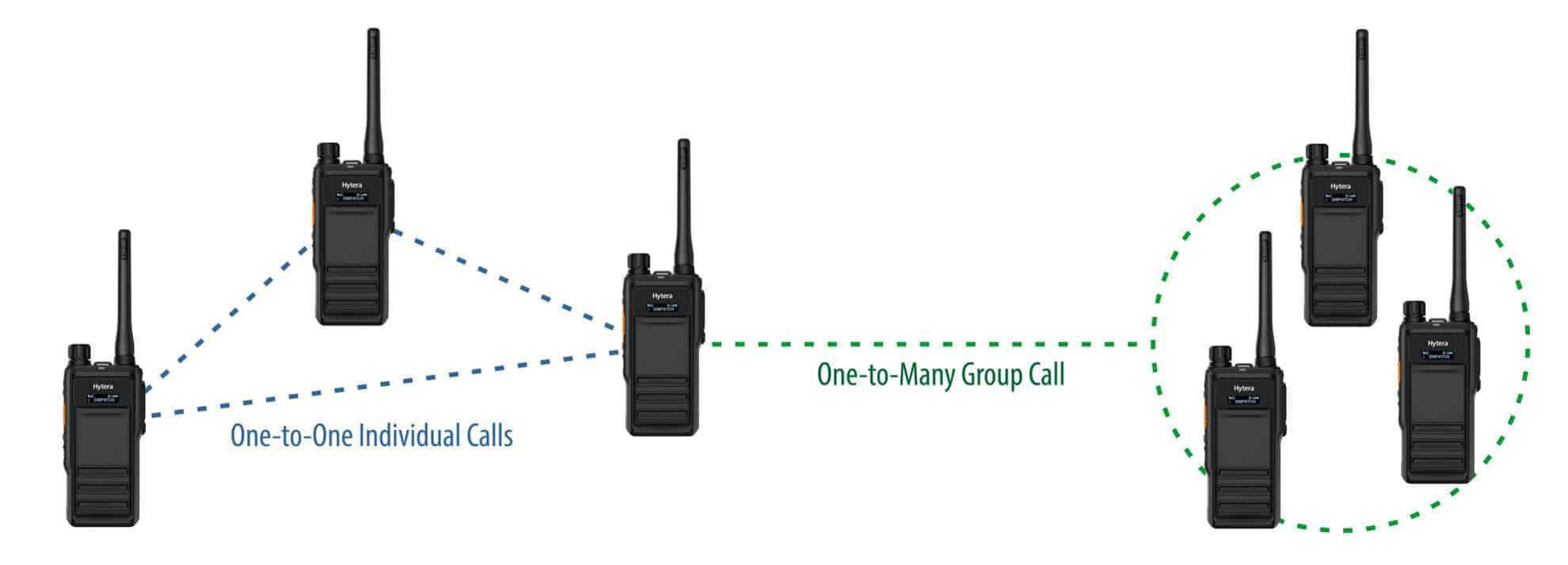
DMR supports several call types that help organizations structure communication around real workflows. Users can make private one-to-one calls, group calls, all-call broadcasts, and emergency calls. Channels, groups, and zones help separate teams by department, location, job function, or operating area.
DMR systems can also support caller identification, telephone interconnect, and gateway connections to other communication systems, including Push-to-Talk over Cellular and analog radio networks.
Digital Data and Dispatch Applications
Because DMR is digital, it can support more than voice communication. Depending on the radio model, system design, software, and programming, DMR can support text messaging, GPS location data, telemetry, radio identification, emergency alerts, and dispatch-related services. Over-the-Air Programming can also help administrators update radios remotely without collecting every device from the field.
Integration with Facility Systems
DMR radios can be configured with programmable input/output functions for integration with facility equipment and control systems. Authorized users may be able to trigger relays, monitor status changes, activate access control points, open gates, connect to PA or alerting systems, or interact with industrial equipment such as pumps, fans, generators, sensors, and control panels.
These integrations can improve workflow efficiency by allowing teams to communicate and take approved actions from the same radio system.
Worker Safety Features
Many professional DMR radios support safety features such as emergency alarms, Man Down alerts, Lone Worker check-ins, priority interrupt, remote monitor, and stun/revive. These tools help supervisors, dispatchers, and safety managers respond faster when a worker is injured, isolated, unreachable, or operating in a hazardous environment.
Scalable System Growth
DMR systems can start with simple radio-to-radio communication and expand over time. Organizations can add repeaters, IP Site Connect, XPT systems for more calling capacity, or Tier III trunking for large and complex networks. This makes DMR a flexible long-term communication strategy, not just a radio replacement.
Why Should You Migrate from Analog to Digital Radios?
Many organizations begin with analog two-way radios because analog systems are familiar and straightforward. As teams grow, analog systems can become limiting. Users may experience channel congestion, inconsistent audio, limited calling flexibility, and fewer options for digital applications.
Migrating from analog to DMR can help organizations modernize their communication system while preserving the practical push-to-talk workflow employees already understand.
Common reasons to migrate include:
- The organization has more users than its analog system comfortably supports.
- Teams need clearer communication in noisy operational environments.
- Supervisors need better group calling and caller identification.
- The organization wants to add dispatching, text messaging, GPS data, or monitoring.
- The existing analog radio fleet is aging and needs replacement.
- The organization wants a system that can scale to repeaters, multiple sites, or trunking.
- A dealer or system integrator recommends a digital system after reviewing site conditions and call traffic.
Phased migration from analog to DMR
A major advantage of many DMR migration plans is that organizations may be able to transition gradually. In some cases, analog and digital operation can coexist during a phased migration, depending on the selected radios, repeaters, programming, licensing, and system design.
A phased approach may look like this:
- Evaluate the current analog system and pain points.
- Confirm licensing, frequencies, coverage needs, and user groups.
- Replace aging radios with DMR-capable radios as budgets allow.
- Program radios to support existing workflows where appropriate.
- Add or upgrade repeater infrastructure when coverage or call capacity requires it.
- Add dispatching, monitoring, IP Connect, XPT, or Tier III infrastructure as communication requirements grow.
This path can help avoid a complete one-time replacement of every radio and system component. However, migration is not automatic. Each deployment should be reviewed by an authorized dealer or qualified radio system professional.
How DMR Systems Scale Over Time
How does DMR Provide a Scalable Growth Path?
A strong DMR strategy does not require every organization to start with the most advanced system. The better approach is to match the system to the current operational need while preserving a practical path for growth.
A small team may begin with radio-to-radio communication. As the team grows, it may add a DMR Tier II repeater to improve site coverage and signal quality. If the organization adds more locations, IP Connect may link those sites. If call traffic increases, XPT may improve group calling capacity. If the organization becomes large or complex enough, DMR Tier III may provide centralized trunking, access control, and system management.
This scalable path helps businesses avoid overbuying early while still planning for future requirements. It also helps dealers and system integrators design systems that solve today’s communication challenges without closing off tomorrow’s options.
What drives the next step up?
Different triggers move an organization from one system level to another.
A move from radio-to-radio to DMR Tier II may be driven by a growing number of radio users, increased site size, and the need for stronger coverage design.
A move from DMR Tier II to IP Connect may be driven by multiple buildings or locations that need to communicate with each other.
A move from IP Connect or conventional Tier II to XPT may be driven by call traffic and group calling capacity.
A move from XPT to DMR Tier III may be driven by large-scale operations, advanced access control, heavy individual calling, wide-area management, and centralized network control.
A dealer or system integrator should evaluate current pain points, projected growth, call traffic, licensing, user roles, and site conditions before recommending a system.
Radio-to-Radio DMR Communication
Radio-to-radio communication is the simplest DMR deployment. In this setup, a group of radios communicates directly with one another without repeater infrastructure.
This can be appropriate for smaller teams, simpler sites, or departments that do not need extended system coverage or advanced infrastructure. For example, a small warehouse, retail operation, hospitality team, or jobsite crew may begin with direct radio communication if the site conditions and user count support it.
How Radio-to-Radio Communication Works
In a radio-to-radio setup, each radio is programmed with the appropriate channels and talk groups. Users select the right channel or group, press the push-to-talk button, and communicate directly with other radios that are programmed to hear that traffic.
Because there is no repeater, the radios depend on their own transmit and receive capabilities. This keeps the deployment simple, but it also limits scalability.
Benefits of radio-to-radio DMR deployments
Radio-to-radio communication can be a practical starting point because it requires less infrastructure. It can also help organizations introduce DMR radios before investing in a larger system design.
Potential benefits include:
- Simple starting point for small teams
- Lower infrastructure complexity
- Familiar push-to-talk operation
- Direct group communication
- Potential path from analog radios to DMR-capable radios
- Easier training for teams that already understand two-way radios
Limitations of Radio-to-Radio Deployments
Radio-to-radio systems have important limitations. The most common limitations are coverage, call capacity, and system control.
Coverage depends on the radios, antennas, building materials, terrain, interference, user locations, and site layout. A direct radio-to-radio system that works in one facility may not perform the same way in another facility. Range or coverage is not guaranteed without a site assessment.
Call capacity is also limited. A small team may be fine with a simple direct setup, but a larger organization with multiple departments, shifts, or concurrent conversations may need repeater or trunking infrastructure.
Radio-to-radio communication is best viewed as the base of the DMR growth path. It can be the right answer for smaller needs, but it is not the end of the DMR system architecture.
DMR Tier II Repeater Systems
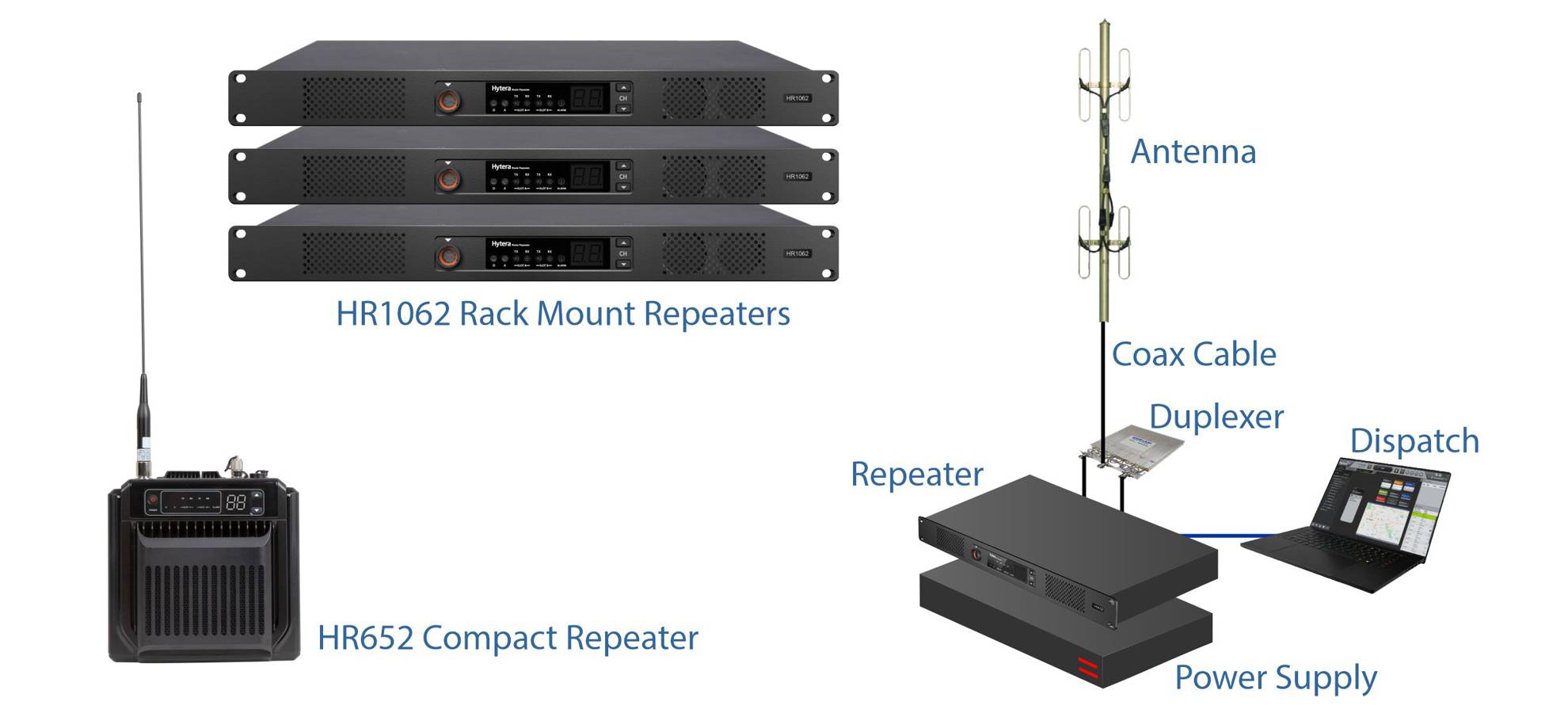
A DMR Tier II system is a licensed conventional radio system that uses rack-mount repeaters and compact repeaters to support professional voice and data communication. This is often the next step after radio-to-radio communication when an organization needs better site coverage, stronger signal reach within a designed area, or more structured communication across user groups.
A repeater receives a radio signal and retransmits it, typically from a higher or better-positioned antenna location. This helps extend the range and improve usability across a facility, campus, business complex, warehouse, yard, or other operational site.
What is in a DMR Tier II repeater site?
A DMR Tier II repeater site may include:
- DMR repeater
- Antenna system
- Coaxial cable and duplexer
- Power supply
- Backup power equipment, when required
- Network equipment, when connected to software or IP systems
- Monitoring tools
- Dispatching software, when needed
The exact design depends on the site and requirements. A professional radio system dealer typically evaluates the building, terrain, user count, frequencies, antenna locations, and call patterns before recommending a system.
Why Do Businesses Use DMR Tier II Systems?
A DMR Tier II repeater system can be useful when a business has outgrown direct radio-to-radio communication. Common triggers include:
- Users need to communicate across a larger facility.
- Radios must work more consistently between indoor and outdoor areas.
- Multiple departments need structured communication.
- Supervisors need group calling and centralized control.
- The business wants dispatching, monitoring, or recording functions.
- The organization wants a foundation for future IP Connect or XPT growth.
Licensing note
Professional DMR Tier II systems generally operate on licensed frequencies. Businesses should confirm FCC licensing and frequency coordination requirements before deploying a system. A qualified dealer, frequency coordinator, or licensing professional should be involved before operation.
IP Connect for Multi-Site DMR Systems
What is IP Site Connect?
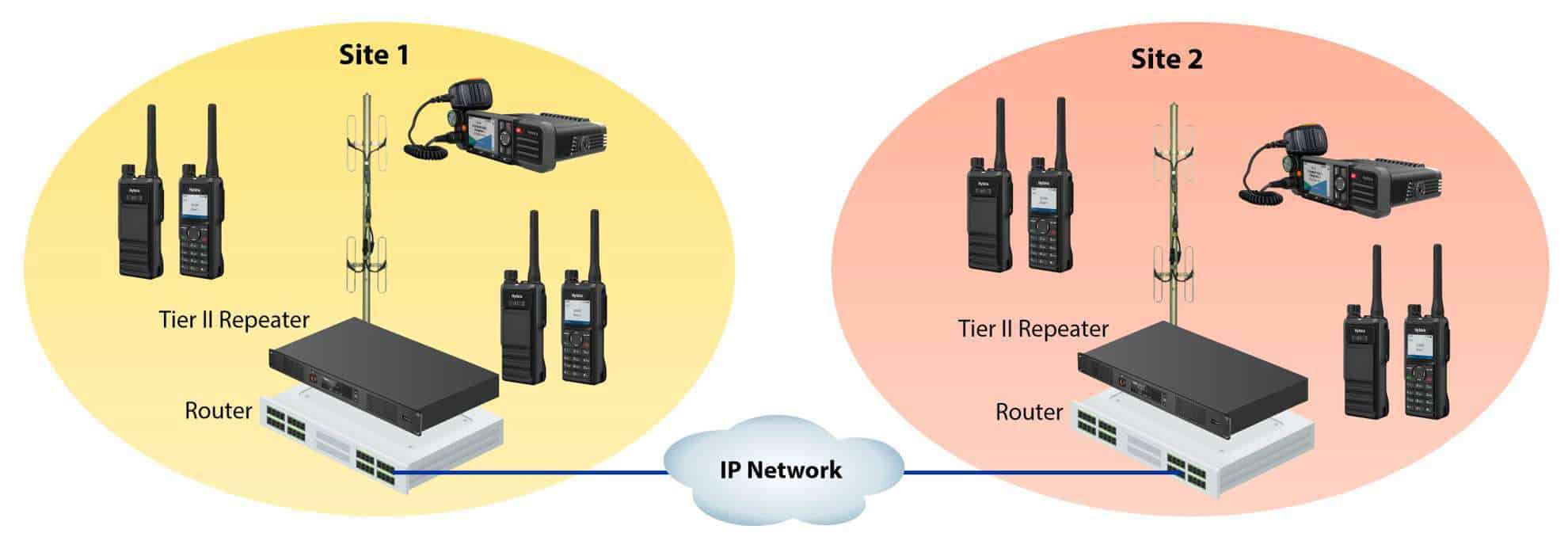
IP Site Connect links multiple DMR Tier II repeater sites over an IP network. This allows users at different locations to communicate across a wider organizational footprint while keeping the familiar DMR radio experience.
A business may consider IP Connect when it has more than one facility, building, campus, distribution center, administrative office, or operational site that needs radio communication between locations.
How IP Connect Works
In an IP Connect system, DMR Tier II repeaters are connected through an IP network. That network may use an internet connection, private LAN or WAN, VPN, microwave link, or other approved network transport. The repeaters remain part of a DMR system, but their traffic can be carried between sites over the IP connection.
For the radio user, the experience can remain simple. Users may select the appropriate channel or talk group and communicate with users at another connected site. The network handles the transport between repeater locations.
When IP Connect is Useful
IP Connect can be useful when:
- A company operates several nearby or regional facilities.
- A school, campus, warehouse network, or business complex needs cross-site communication.
- A logistics operation needs coordination between administrative, warehouse, and yard teams.
- Local teams need their own site communication but also need access to other locations.
- The organization wants to expand geographic reach without moving directly into trunking.
IP Connect Limitations
IP Connect expands site-to-site connectivity, but it does not automatically solve every capacity problem. If too many users or talk groups need simultaneous communication, call capacity can still become a limiting factor. That is when trunking options such as Hytera XPT or DMR Tier III may become appropriate.
Network quality also matters. IP Connect depends on network connectivity between sites. Latency, jitter, packet loss, firewall configuration, and network reliability should be considered during system planning.
Hytera XPT Trunking Systems
Hytera XPT, or Extended Pseudo Trunking, is a Hytera DMR system approach that increases group calling capacity by allowing multiple repeaters to work together more efficiently. XPT is based on DMR Tier II conventional architecture but adds trunking-style behavior for organizations that need more group call capacity without moving directly to a full DMR Tier III system.
XPT is commonly positioned for organizations that have outgrown a conventional repeater system and need better channel utilization for high-volume group communication.
How XPT Works
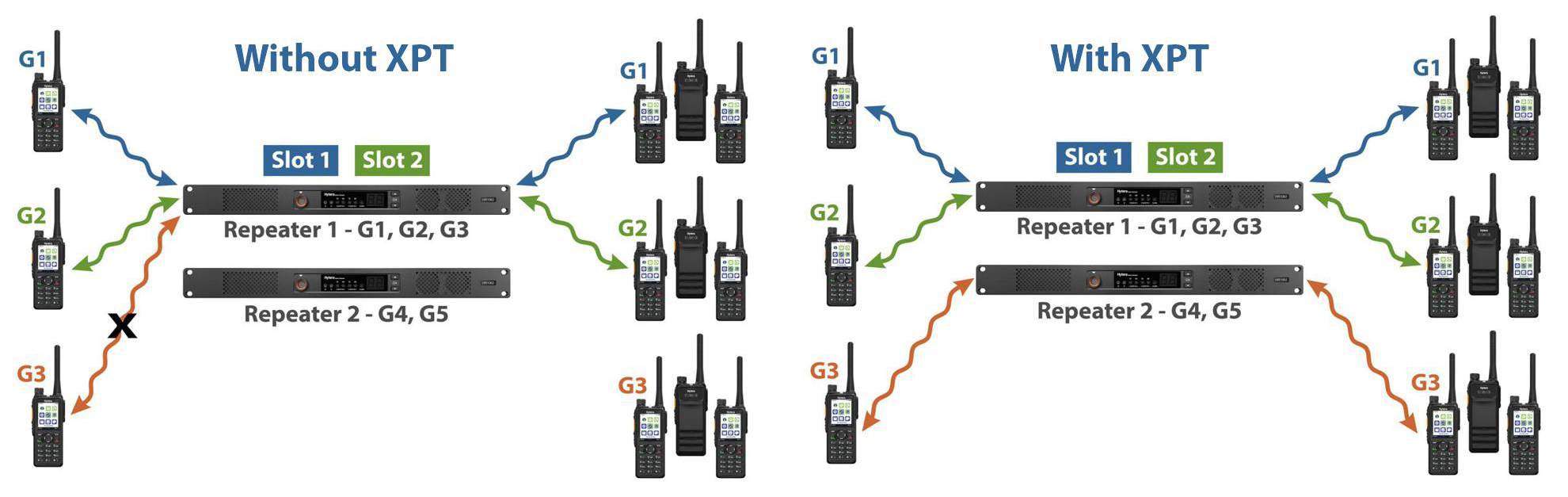
In a conventional repeater setup, talk groups may be assigned to specific channels or repeaters. If one group’s assigned repeater is busy, users may encounter busy conditions even if another repeater has an available time slot.
XPT helps manage this more dynamically. It allows radios to use available repeater resources within the XPT system, improving channel utilization and reducing the likelihood that an available communication path is left unused.
In plain language, XPT helps the system make better use of the repeaters already deployed.
Why Do Organizations Choose XPT?
XPT may be appropriate when:
- Multiple departments use the radio system heavily.
- Group calls are frequent.
- A conventional repeater system is becoming congested.
- The organization needs more capacity but wants to avoid unnecessary infrastructure complexity.
- Multi-site growth is expected.
- The business wants a scalable path from DMR Tier II infrastructure.
XPT and Multi-site Growth
XPT can be deployed at a single site or across multiple sites when supported by the proper network design and system configuration. Multi-site XPT can support organizations that need both higher call capacity and communication between locations.
XPT Limitations
XPT is a Hytera system technology. Because it is not the same as open-standard DMR Tier III trunking, system compatibility and equipment requirements must be verified.
XPT may not be the right choice for every high-capacity system. Organizations that need more advanced individual call management, comprehensive access control, centralized radio management, or large-scale trunking may need to evaluate DMR Tier III.
DMR Tier III Trunking Systems
DMR Tier III is an advanced trunked radio system designed for large, complex communication environments. It uses a centralized network architecture to manage radio users, talk groups, sites, call priority, traffic channels, and system access.
Tier III is typically considered when an organization needs a large-scale, high-capacity radio network with advanced management and control. It is a major step up from conventional repeater systems and is usually designed by experienced radio system integrators.
How DMR Tier III Works
A DMR Tier III system uses trunking. Instead of assigning users to fixed channels in the same way as a conventional system, the system dynamically assigns available communication resources as needed.
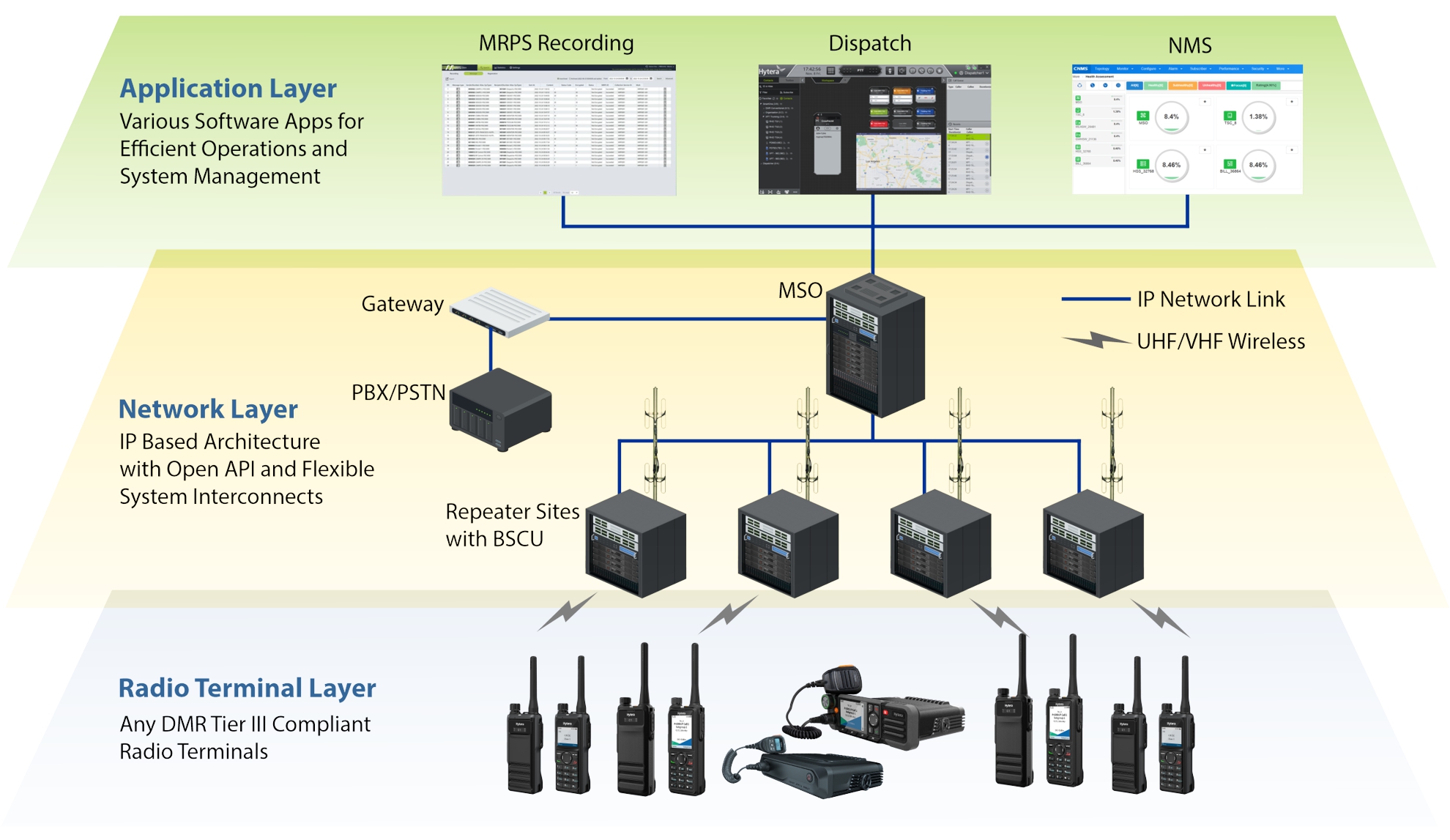
The DMR Tier III Trunking System consists of a central controller called a Mobile Switching Office (MSO), a Base Station Controller Unit (BSCU) server at each radio repeater site, multiple repeaters to carry the traffic, and a wide area network that connects all the different pieces together. Like IP Connect, IP network connectivity is provided by a variety of third-party internet, LAN, or VPN network operators. All the radio sites connect to the MSO, which provides the routing functions, the gateways to telephone networks and other systems, as well as managing the trunking of calls across the system. The MSO offers high availability standby, while multi-level fallback options can be deployed to ensure high reliability.
The system consists of three layers: the application layer, the network layer, and the radio terminal layer.
DMR Tier III requires a dedicated FCC FB8 frequency control channel that is always available for radios to register and request service from the network. When a user presses PTT, the system determines which resource should carry the call. This helps large systems use available frequencies and repeaters more efficiently.
Why Do Organizations Choose DMR Tier III?
DMR Tier III may be appropriate when:
- The radio network serves many users.
- Individual calls and group calls both need efficient routing.
- The organization needs wide-area or multi-site communication.
- System administrators need granular access control.
- Dispatchers need advanced tools.
- User management, call priority, and monitoring are important.
- The system requires a long-term growth path with centralized management.
DMR Tier III and Radio Registration
A key advantage of Tier III is user and radio management. Radios can register with the network, and the system can manage access based on the radio identity and assigned permissions. This helps administrators control who can connect, what groups they can access, and what level of priority they may have.
What to Evaluate Before Choosing a DMR Radio System
Before selecting a DMR system, businesses should confirm the operating environment, user count, talk group structure, coverage area, capacity requirements, licensing status, indoor and outdoor coverage challenges, dispatch needs, GPS or data requirements, and migration plan from analog, if one exists.
Is a DMR system right for your business? Answer these questions to find out:
- How many users need to communicate during a normal shift?
- How many talk groups need to operate at the same time?
- Is the system single-site, multi-building, multi-campus, or wide-area?
- Does the organization need dispatch, GPS, recording, or system monitoring?
- Are existing analog radios or licenses part of the migration plan?
- Does the site need Tier II, IP Site Connect, XPT, or Tier III capabilities?
- Which radios, repeaters, accessories, and software are verified for the intended system?
A well-planned DMR system should match the way your organization actually communicates, not just the number of radios it needs to buy. By confirming users, talk groups, coverage expectations, capacity requirements, data needs, dispatch workflows, and future expansion plans before deployment, businesses can choose a DMR architecture that supports daily operations, improves communication efficiency, and leaves room to scale as requirements change.
Dispatching Consoles
What is a DMR Dispatch Console?
A dispatch application, also called a dispatching console, gives authorized users centralized communication control. Dispatching supports voice calls, GPS location tracking, messaging, recording, user status and system access, and system monitoring. DMR dispatch applications are typically server-based applications accessed by PCs, and are deployed on wide-area IP Connect, XPT, and DMR Tier III systems.
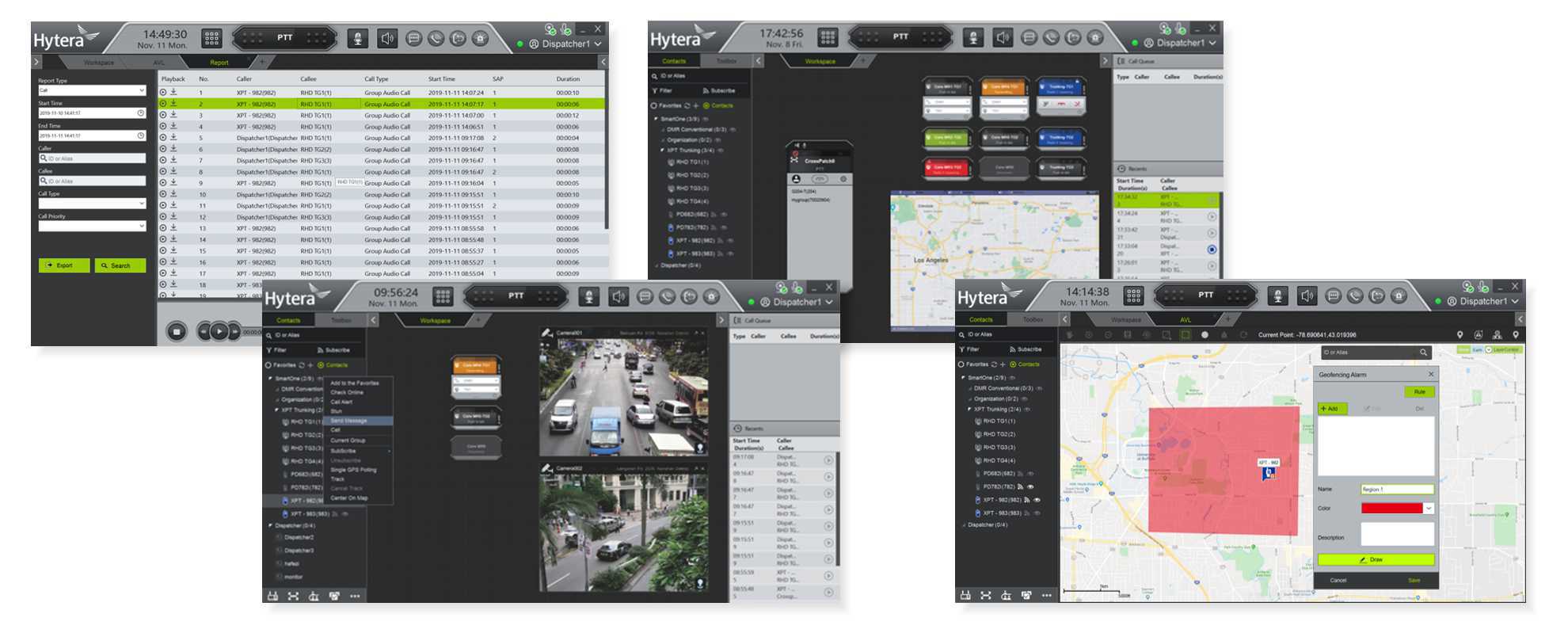
Functions provided by DMR dispatching applications:
- Integration of dispatching, voice recording, SDS messages, GPS, CCTV cameras and gateway services in one central application
- Connection of DMR, Analog, and other radio systems, as well as PABX and PSTN phone systems using a software gateway
- Support of control room workstations using a graphical expansion to several monitors
Monitoring DMR Systems
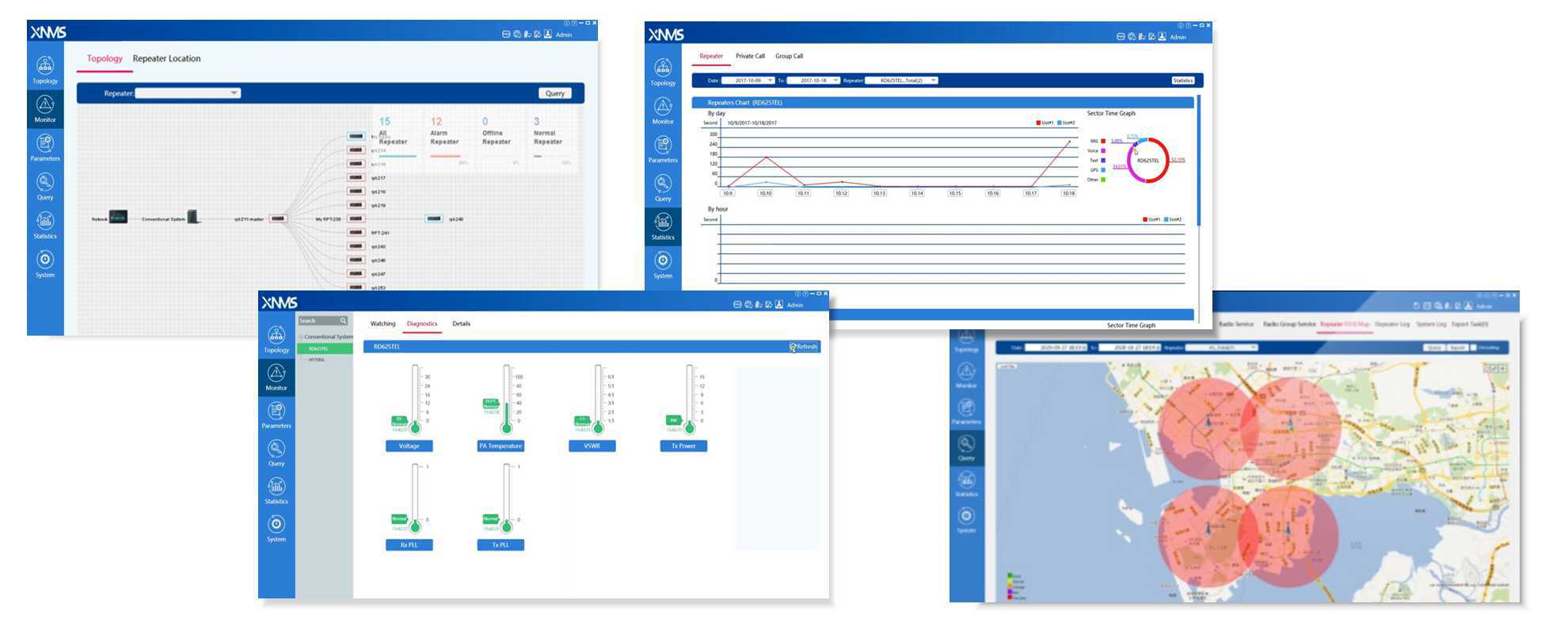
DMR monitoring systems enable centralized monitoring and control of all connected repeaters. DMR network operators benefit from real-time system monitoring, automated alerts, and detailed usage reporting, which collectively improve operational efficiency and reduce downtime. Monitoring and remote management applications help administrators identify repeater power issues, antenna problems, call traffic patterns, or other system events.
DMR monitoring systems proactively address performance issues through remote diagnostics and alert-triggered responses helping prevent service interruptions and maintaining consistent network reliability across locations. They support coverage mapping, repeater access control, and automated service reporting to streamline system maintenance, and ultimately increase the resilience and dependability of the communication network.
Frequently Asked Questions
A DMR radio system is a digital two-way radio communication system based on the Digital Mobile Radio standard. It can support push-to-talk voice, group calls, individual calls, digital data, repeaters, dispatching, IP-connected sites, and trunking, depending on the system design.
DMR stands for Digital Mobile Radio. It is an open digital radio standard used for professional mobile radio communication.
DMR can improve radio communication by supporting digital voice, efficient channel use, group calling, caller identification, data services, and scalable system architecture. Actual performance depends on the radios, system design, site conditions, licensing, and configuration.
TDMA stands for Time Division Multiple Access. In DMR, TDMA divides one 12.5 kHz channel into two alternating time slots, allowing two communication paths to share the same channel.
Radio-to-radio DMR communication is the simplest deployment, where radios communicate directly without repeater infrastructure. It can work for smaller teams or simpler sites, but coverage and call capacity are limited by the radios and environment.
A business may need a DMR repeater when direct radio-to-radio communication does not provide the desired site coverage, signal quality, or communication structure. A dealer should evaluate the site before recommending repeater placement or system design.
A DMR Tier II system is a licensed conventional DMR radio system that can use repeaters for professional voice and data communication. It is commonly used by organizations that need structured communication across a facility, campus, business complex, or operational site.
IP Connect links multiple DMR Tier II repeater sites through an IP network. It allows users at different locations to communicate through connected repeater sites while continuing to use familiar DMR radio workflows.
Hytera XPT, or Extended Pseudo Trunking, is a Hytera DMR system technology that helps multiple repeaters share call traffic more efficiently. It can improve group calling capacity for organizations that have outgrown conventional repeater operation.
DMR Tier III is an advanced trunked DMR system designed for large or complex communication networks. It uses centralized system control, a dedicated control channel, dynamic resource assignment, user management, and wide-area network architecture.
In some cases, organizations can migrate from analog to DMR in phases. The migration path depends on existing radios, new radio models, repeater equipment, licensing, programming, and system design. Compatibility should be verified before publication or deployment.
No. DMR does not guarantee coverage by itself. Coverage depends on the radio system design, antenna placement, building materials, terrain, interference, frequencies, radio equipment, and site conditions.
Many professional DMR radio systems use licensed frequencies and require FCC licensing or frequency coordination in the United States. Requirements depend on the frequency, service, equipment, and system design. Businesses should confirm requirements before operation.