
What is the Difference Between Analog and Digital Two-Way Radios?

Analog vs Digital Two-Way Radios
Analog two-way radios transmit voice using analog modulation, typically frequency modulation (FM), over licensed UHF or VHF radio channels. Analog technology has provided reliable business communications for decades and remains useful for organizations with straightforward voice-communication requirements.
Hytera was a pioneering organization of Digital Mobile Radio, or DMR technology. DMR adds digital voice encoding, signaling, and data capabilities while continuing to use professional land-mobile-radio frequencies. DMR provides several advantages over conventional analog radio, including greater channel capacity, more consistent audio quality within the usable coverage area, improved battery efficiency, and support for functions such as individual calling, text messaging, GPS data, and encryption.
Analog two-way radios have been the standard for decades. Analog radios have reached the peak of their advancement. They are simple to use and are often all that is needed on a personal level. When an individual or company needs a more advanced radio that is capable of location services, messaging, and other data functions, they look to digital radios.
Push-to-Talk over Cellular is another digital technology, but it operates differently from DMR. PoC systems such as HORIZON use 4G/LTE and 5G cellular networks and Wi-Fi rather than conventional UHF or VHF radio infrastructure.
How Digital DMR Works
Both analog and digital radios send signals over a radio channel using a Very High Frequency (VHF) or Ultra High Frequency (UHF) carrier frequency wave.
In simple terms, analog radios use frequency modulation (FM) to encode a voice signal within a carrier wave. Your voice changes, or modulates, the frequency of the wave. The difference between the modulated frequency and the baseline channel frequency can then be demodulated by the receiving radio and turned back into a comprehensible voice message.
Analog FM represents the user’s voice through continuous variations in the transmitted radio signal. DMR first converts speech into digital information using a vocoder. The encoded voice, signaling, and error-protection information is then transmitted using digital 4FSK modulation.
DMR also uses two-slot Time Division Multiple Access, or TDMA. On a standard 12.5 kHz DMR carrier, the two time slots can support two independent communication paths.
DMR is an open digital radio standard developed by ETSI (The European Telecommunications Standards Institute). Standards compliance provides a common air-interface foundation that supports interoperability among compliant equipment, although specific features and system functions should be verified between manufacturers and models. The DMR standard consists of DMR Tier I, Tier II, and Tier III. Each tier provides different functionality and coverage range.
Learn more about the different DMR Tiers
Digital radios provide several advantages and additional benefits compared to analog radios:
Increased Channel Capacity
DMR uses two-slot TDMA to divide a 12.5 kHz radio carrier into two alternating time slots. In repeater operation, the two slots can support two independent communication paths on the same licensed frequency pair, effectively doubling call capacity compared with a conventional analog repeater using the same 12.5 kHz channel.
DMR radios with advanced trunking technology can support hundreds of channels. Digital Push-to-Talk over Cellular radios have far greater channel capacity.
Longer Range
A standard analog radio is going to decrease in signal the closer you get towards its maximum range, at which point, all you hear is white noise. On the other hand, a digital radio is going to remain much more consistent in sound quality regardless of distance to or from the maximum range.
An analog radio and digital radio with the same transmission power radio will transmit over the same distance, the digital radio will remain loud and clear all the way to the end of the covered area whereas the analog radio will gradually fade towards the end of the covered area.
DMR systems can also connect multiple repeater sites over IP networks to provide communications across separate buildings, campuses, or geographically distributed locations. Additionally, DMR supports digital voice along with defined signaling and data services such as text messaging, GPS information, radio identification, and control functions.
Clearer Audio
Analog signals are typically less tolerant to external noise interference, which means lots of unwanted background noise that can get in the way of crisp and clear communications. In other words, noise adds extra random information to analog signals. Each time the signal is amplified the noise is also amplified.
DMR incorporates digital voice coding and error-protection mechanisms that help preserve intelligibility as radio conditions deteriorate. In addition, select Hytera DMR radios provide digital or AI-based noise-cancellation features that reduce environmental background noise and emphasize speech. These audio-processing capabilities vary by radio model. This means that the received audio quality is enhanced when compared to an analog radio system.
Digital technology also allows the receiving radios to correct some transmission errors in the received signal to maintain audio quality at the extremes of the radio coverage. Hytera digital radios contain unique technology that filters communication channels, fills in microscopic gaps, breaks in transmission, and minimizes error rates.
Digital radios can make your communications clearer by reducing unwanted background audio and focusing on the wanted speech. Increased audio quality in poor coverage areas reduces the need to repeat information and improves efficiency.
Longer Battery Life
DMR’s TDMA architecture can also improve battery efficiency. During a DMR call, the radio transmits during its assigned time slot rather than continuously, reducing transmitter power consumption. Under a typical 5/5/90 duty cycle, this can provide up to 40% more operating time than comparable analog operation. Actual battery runtime depends on the radio, battery capacity, transmit power, signal conditions, enabled features, and usage.
Learn more about charging radios and extending battery life
Security and Privacy
DMR can support digital privacy and encryption features that are not available in the same way on basic analog radio systems. Encryption is optional and depends on the radio model, system configuration, licenses, and applicable regulations. Buyers should not assume that a digital radio transmission is encrypted simply because it uses DMR.
GPS and other Advanced Features
Additional capabilities enabled by digital radio technology can include:
- GPS tracking
- Text messaging
- Private calls
- Group calls
- Safety features
Trunking
Trunked radio systems are two-way radio systems that optimize voice call or data traffic through a limited number of frequencies, maximizing the available resource for a large group of users. Trunking dynamically assigns available radio resources among users and talk groups, allowing larger organizations to use multiple channels more efficiently than fixed conventional channel assignments.
DMR Tier III is a standards-based trunking architecture that uses dedicated control-channel resources to register radios, process call requests, and dynamically assign available traffic channels. It is designed for enterprise-level applications and higher-capacity networks with many users, talk groups, and radio sites.
Compatible DMR repeaters can also be connected over IP networks to create multisite radio systems that link separate coverage areas.
Migrating from Analog to Digital DMR Radios
Analog to Digital Migration Path
Many Hytera DMR radios support both conventional analog FM and digital DMR operation. This allows organizations to introduce compatible DMR radios into an existing analog fleet and program them for analog operation during the transition. As additional radios are replaced, users and channels can be migrated to DMR without requiring the entire fleet to be replaced at once.
Taking Advantage of Digital Two-Way Radios
Migrating from analog to digital two-way radios offers numerous benefits, including superior audio quality, increased call capacity, better coverage, longer battery life, enhanced privacy and security, and advanced features like GPS and text messaging. Hytera digital radios are among the best on the market, offering versatility, durability, interoperability, and advanced features that enhance communication and increase efficiency.
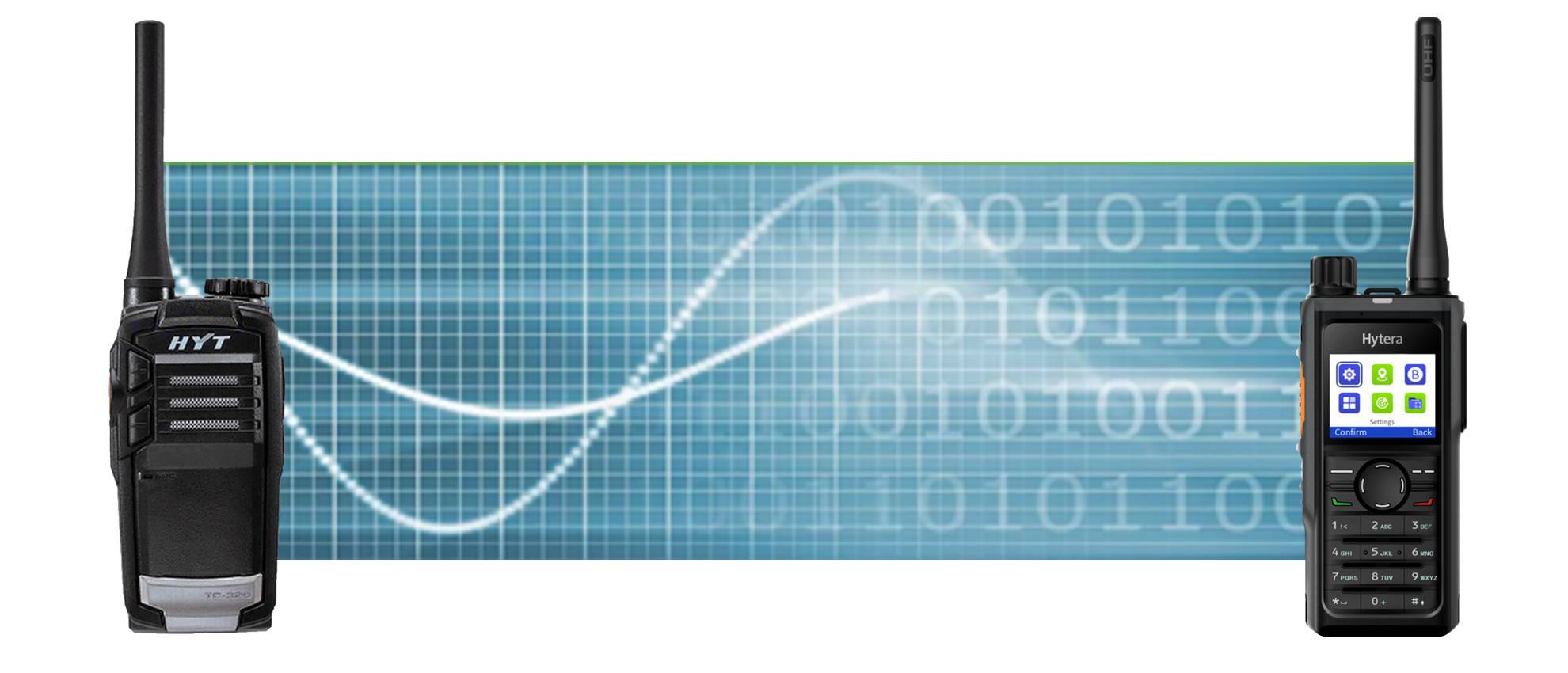
Investing in digital two-way radios is a smart decision for any business or organization that relies on clear and reliable communication.
Simple and Cost-Effective Migration Path
Users with existing analog radios can easily and gradually migrate to DMR radios. This is because Hytera DMR radios support both digital and analog modes. This enables a cost-effective migration path without a one-time and upfront system purchase. DMR radios can be added over time to an existing analog system as the legacy analog radios need to be replaced.
Organizations that need extended local coverage can also add a DMR Tier II repeater system. The timing of the repeater deployment depends on the existing system, licensed frequencies, coverage requirements, radio compatibility, and migration plan. An authorized Hytera dealer can perform a site assessment, help plan channels and talk groups, program the radios, and design and install the appropriate repeater system.
DMR systems can be designed with scalable repeater infrastructure, dispatching, monitoring, and backup-power options as communication requirements grow.
Contact Hytera to learn more about Hytera DMR Radios and Push-to-Talk over Cellular Radios.
Frequently Asked Questions
Analog radios send voice as a continuous signal, while digital radios convert voice into digital data for improved features, capacity, and audio performance.